Unraveling the Transport of Solar Energetic Particles with Multi-Spacecraft Observations —Toward Improved Space Weather Forecast—


Abstract:
A unique solar energetic particle (SEP) event on March 30, 2022, is analyzed using simultaneous observations from the BepiColombo and STEREO-A spacecraft. Located at heliocentric distances of 0.6 and 1.0 AU, respectively, the two spacecraft were aligned along the same magnetic field line, providing a valuable opportunity to investigate particle transport in the inner heliosphere. By assimilating multi-spacecraft observation data into numerical simulations, we examine the particle transport process between these locations. The results reveal that particles gradually deviate from ballistic motion over time due to magnetic field fluctuations. Our framework, which integrates multi-spacecraft observations with numerical simulations, contributes to a better understanding of SEP physics and improves their prediction.
Introduction:
Solar Energetic Particles (SEPs) are high-energy charged particles ranging from a few keV to several GeV produced by energetic phenomena on the Sun, such as solar flares and coronal mass ejections (CMEs), and subsequently ejected into interplanetary space. Understanding their origin and dynamics is crucial for predicting SEP profiles at Earth, as SEPs with energies above 10 MeV pose significant threats to modern society, causing radio communication failures, malfunction and degradation of equipment onboard aircraft and satellites, and radiation exposure of astronauts. This effort, known as space weather forecast, is expected to grow in importance as human activities expand beyond the Earth’s magnetosphere.
Once released from the Sun, SEPs propagate through interplanetary space and can be observed by in situ spacecraft. At present, many spacecraft measure SEPs at various heliocentric distances and longitudes, enabling detailed investigations of their dynamics through simultaneous multi-point observations. In this study, we analyzed a unique SEP event that occurred on March 30, 2022, observed simultaneously by the BepiColombo and STEREO-A spacecraft located at heliocentric distances of 0.6 and 1.0 AU.
Results:
Figure 1 shows the inferred spacecraft locations and the magnetic field configuration.
Since SEPs propagate primarily along magnetic field lines, the two spacecraft are expected to observe the same population at different times. Figure 2 presents the time profiles of ~1-10 MeV protons observed by the BepiColombo and STEREO-A spacecraft. Two distinct components are evident at the STEREO-A location: a highly fluctuating early component and a subsequent long-lasting component. A similar long-lasting component is also observed at the BepiColombo location, indicating that they originate from the same particle population. Detailed analysis suggests that particles propagate ballistically in the early phase but become increasingly delayed relative to ballistic expectations over time. To understand this behavior, we conduct numerical simulations of particle transport between the two spacecraft locations. Using the observation from BepiColombo at 0.6 AU as input, we predict the particle profile at 1.0 AU and compare it with the STEREO-A observation. A data assimilation technique is applied to infer model parameters that well reproduce the observations. Figure 3(a) shows good agreement between the simulated and observed particle profiles at 1.0 AU. Figure 3(b) presents the inferred particle mean free path as a function of time, revealing a gradual decrease. This indicates that particles progressively deviate from ballistic propagation as their motion is disturbed by their surroundings. Figure 3(c) shows the theoretically predicted mean free path from magnetic field observations at the STEREO-A location. The similarity in the temporal behaviour between panels (b) and (c) suggests that magnetic field fluctuations play a key role in modulating particle transport.
Perspective:
Solar Energetic Particles produced by solar activity pose significant threats to modern society, and their risks are expected to increase as human activities expand beyond the Earth’s magnetosphere. Therefore, understanding and predicting when, where, and to what extent these particles will arrive remains a crucial challenge. We address this challenge by integrating multi-spacecraft observations with numerical simulations. In the future, we will further advance this approach to develop a comprehensive model that includes particle acceleration, transport and impact assessment. This effort will contribute to space weather forecast in the era of international deep space exploration.
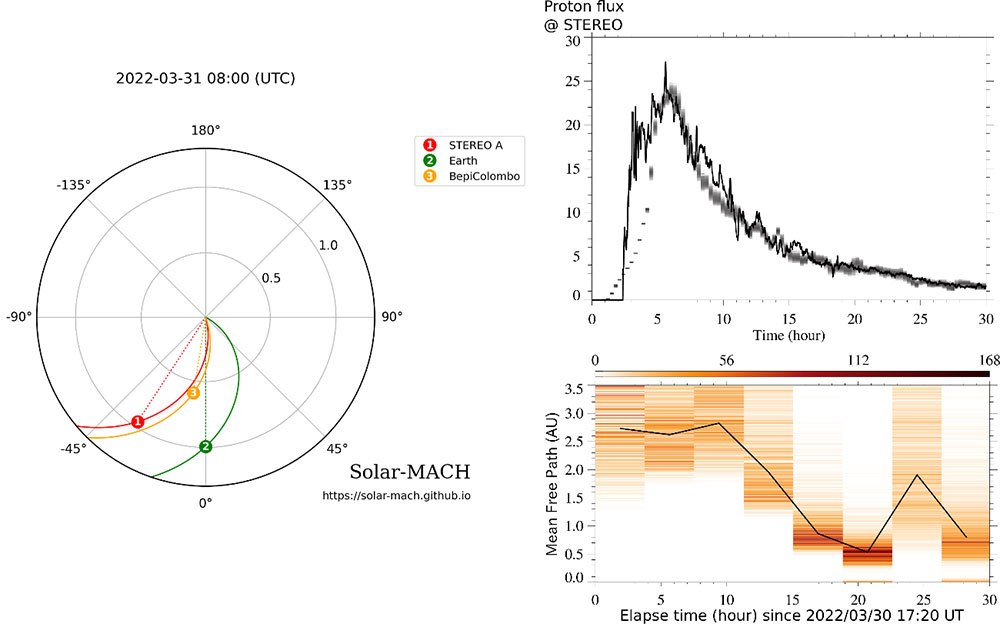
Graphical Abstract
(Left): Inferred spacecraft locations and the magnetic field configuration during the event. The sun (center of the diagram) is viewed from the north.
(Top right): Proton flux at the STEREO-A location obtained from numerical simulations (gray shading) and the observation (solid line).
(Bottom right): Mean free path inferred from the data assimilation.
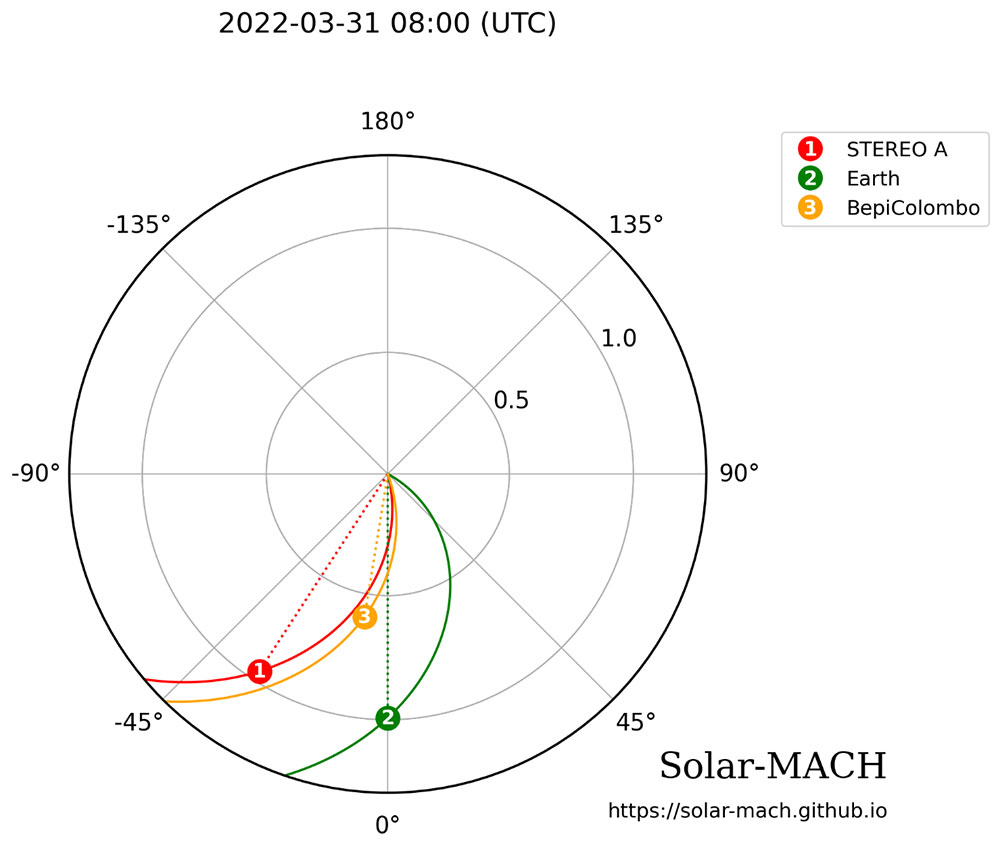
Figure 1 Inferred spacecraft locations and the magnetic field configuration during the 2022/03/30-31 SEP event. The sun (center of the diagram) is viewed from the north. Red and orange circles represent the locations of STEREO-A and BepiColombo, and the solid lines of the same color indicate magnetic field lines passing through the corresponding spacecraft.
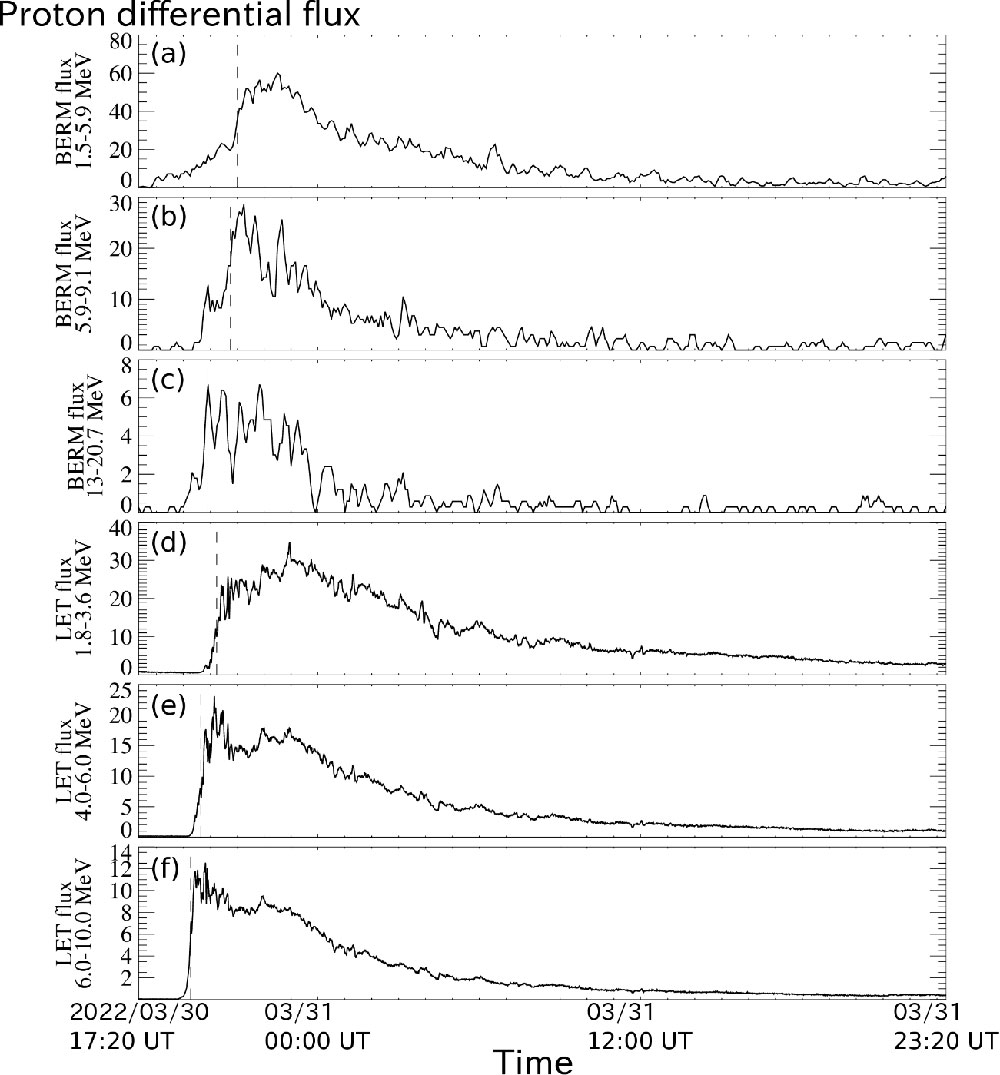
Figure 2 Time profiles of the proton differential flux observed by (a-c) BepiColombo and (d-f) STEREO-A.
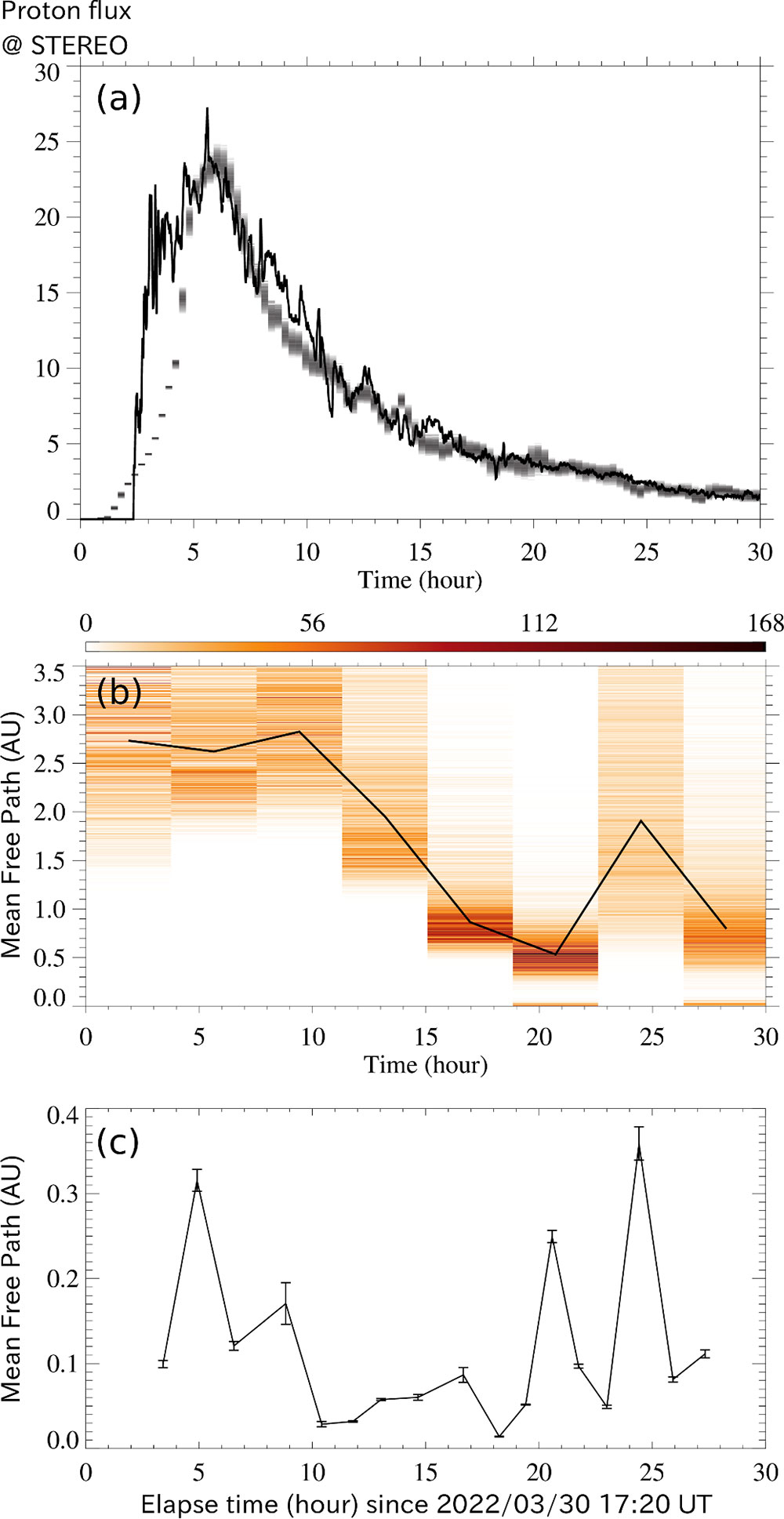
Figure 3 (a) Proton flux at the STEREO-A location obtained from numerical simulations (gray shading) and the observation (solid line). (b) Mean free path inferred from the data assimilation. (c) Mean free path theoretically predicted from magnetic field observations.
Takashi Minoshima (JAMSTEC)
Yoshizumi Miyoshi (ISEE, Nagoya University)
Go Murakami (ISAS/JAXA)
Marco Pinto (ESA)
Daniel Schmid (Space Research Institute, Austrian Academy of Sciences)
Ayako Matsuoka (Kyoto University)
Wolfgang Baumjohann (Space Research Institute, Austrian Academy of Sciences)
David Fischer (Space Research Institute, Austrian Academy of Sciences)
Kazumasa Iwai (ISEE, Nagoya University)
Shinsuke Imada (University of Tokyo)
Contacts:
(For this study)
Takashi Minoshima, Researcher, Research Institute for Earth and Information Sciences (REIS), Center for Mathematical Science and Advanced Technology (MAT), Computational Science and Engineering Group, JAMSTEC(For press release)
Press Office, Business Promotion Department, Planning Division, JAMSTECNagoya University General Affairs Department Public Relations Division