Visualizing Microbial Chitin Degradation at the Nanogram Scale
A Deep-Sea-Inspired Approach to Visualizing Interfacial Reactions



Shizuoka University
Kyokuto Pharmaceutical Industrial Co., Ltd.
For the first time, microbial chitin degradation can be directly visualized at the nanogram scale.
Key Points
- Direct visualization of microbial chitin degradation at solid–liquid interfaces
- Ultrasensitive detection at the nanogram scale
- Label-free detection of localized enzymatic activity
Chitin and cellulose are among the most abundant biopolymers on Earth, yet how they are degraded by microorganisms has remained largely invisible to direct observation. Because these materials are insoluble, degradation occurs locally at solid–liquid interfaces—making the process effectively invisible to conventional analytical methods.
A research team led by JAMSTEC has now developed a method to directly visualize this process. By extending their previously established SPOT (Surface-Pitting Observation Technology), the researchers succeeded in making chitin degradation visible for the first time at an ultrasensitive level of a few nanograms.
The method uses a nanofibrous hydrogel that amplifies minute surface changes. When microorganisms degrade chitin, tiny pits form on the surface. These pits can be directly observed, revealing where and how degradation occurs.
This approach provides a fundamentally new way to study interfacial enzymatic reactions—without labels or chemical probes. It is expected to enable the discovery of useful degradative enzymes and microorganisms for biomass utilization, and to extend to a wide range of material systems where interfacial degradation processes are critical.
This work is part of a broader research framework known as “deep-sea-inspired chemistry,” which translates principles from extreme environments into design strategies for materials and processes. By further developing this concept, the team aims to expand its application to diverse material and process designs, driving interdisciplinary innovation toward sustainable resource utilization. Deep-sea-inspired technologies are already attracting growing attention for their potential in real-world applications.
The study was supported by JSPS KAKENHI, JST CREST, and the International Science and Technology Foundation. The results were published online in Langmuir on June 19, 2026.
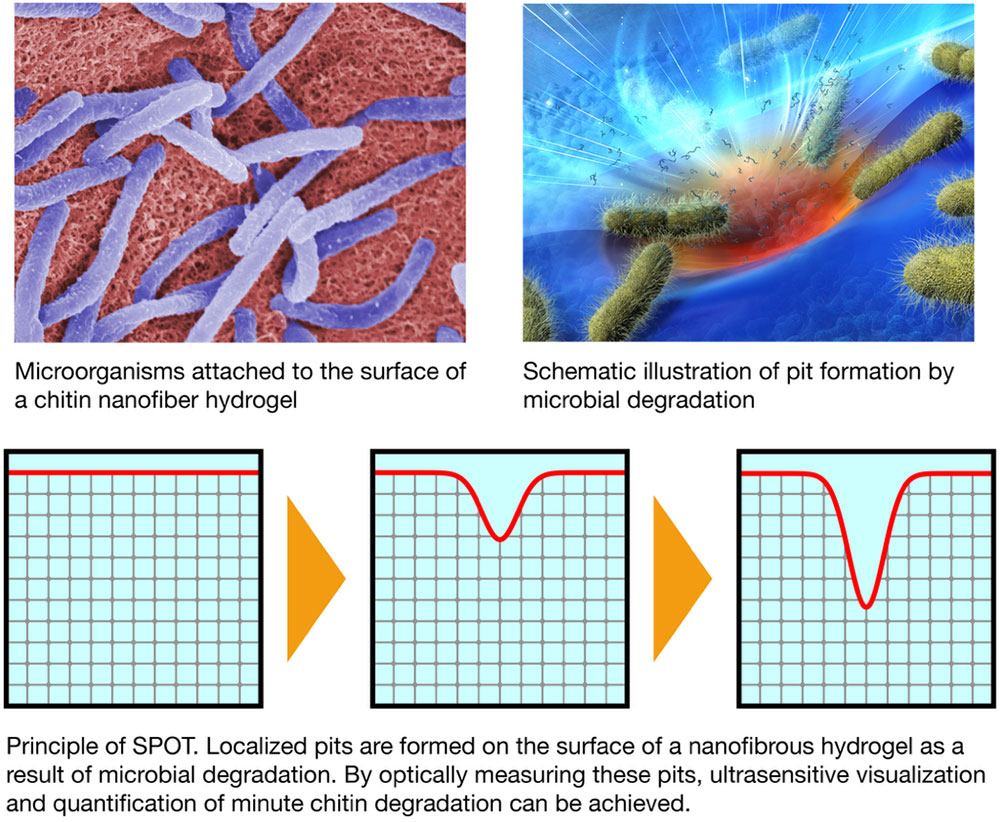
Figure 1. Schematic illustration of chitin degradation visualized using the SPOT technique developed in this study
When microorganisms degrade chitin on the surface of a nanofibrous hydrogel, localized material loss occurs, resulting in the formation of microscopic pits. By observing these pits, the degradation of water-insoluble chitin can be visualized and quantified with high sensitivity.
Contacts
(For this study)
Shigeru Deguchi, Principal Researcher, Institute for Extra-cutting-edge Science and Technology Avant-garde Research of Life (X-star), JAMSTEC(For press release)
Press Office, Business Promotion Department, Planning Division, JAMSTECPublic Relation Unit, Public Relations and Funding Section, General Affairs Department, Shizuoka University
Product Development Division, Kyokuto Pharmaceutical Industrial Co., Ltd.