A New Mathematical Tool to Uncover "Who Eats Whom" in Nature Reconstructing complex food webs from simple trophic position data using the Superposition Method


Tohoku University & JAMSTEC
Advanced Institute for Marine Ecosystem Change (WPI-AIMEC)
Understanding "who eats whom" is the key to keeping our oceans alive—and our dinner plates full. However, this invisible network that makes up the food chain can unravel with the pull of just one thread. Overfish one species, and its predators starve. Cut off a tiny prey species, and the entire food chain collapses - including us.
The intricacies of this web have remained a mystery, as traditional ecological research is almost forensic, incredibly slow, and strictly limited to the number of species scientists can physically collect during fieldwork. To find a better way, marine science had to look outside the ocean entirely and delve into an unexpected specialty: mathematics.
New research published in Methods in Ecology and Evolution on August 6, 2026, blends marine science and engineering mathematics to solve the "impossible" problem of this chaotic web. The resulting algorithm reconstructed the invisible ocean networks with 80% accuracy, essentially turning the invisible visible.
Enter Dr. Ettore Barbieri, a senior researcher at the Japan Agency for Marine-Earth Science and Technology (JAMSTEC) and a researcher at the Advanced Institute for Marine Ecosystem Change (WPI-AIMEC). With a focus on engineering mathematics, he wasn't studying fish at all. However, a chance encounter changed everything.
At a seminar, ecologist Dr. Naoto F. Ishikawa, Group Leader of JAMSTEC’s Organic Molecule Research Group, was explaining how scientists can use chemical signatures in the lab—called stable isotope analysis—to give each animal a "ranking" or hierarchy in the food web: the trophic positions. Listening in the audience, Barbieri saw a striking parallel to his own engineering work.
"I asked him: if you already know the rankings of the animals, can you calculate exactly who is eating whom?" Barbieri recalls. "I already knew the conventional mathematical answer was an absolute no."
Ishikawa agreed; the math simply didn't work backwards. Too many different combinations of predators and prey could produce the exact same rankings.
"Then I thought about it," Barbieri says, "and asked: what if I told you there is a way?"
The two researchers teamed up and boldly embraced a paradox: they stopped looking for one perfect answer and focused on calculating probabilities instead.
The math fails when a predator eats dozens of different things at once, but it works perfectly if a predator only eats two things. So, the team broke the food web down into tiny pairs. They discarded highly unlikely pairings—like a sardine eating a shark—and used a classic statistical tool called Bayes’ theorem to calculate the probability of each remaining pair based on real-world biological data.
By layering thousands of these simple, two-prey probabilities on top of each other, a clear picture of the whole ecosystem began to emerge. They tested the algorithm on 158 fully documented ecosystems from a global database, without any information about real food webs.
The results were staggering.
The algorithm reconstructed the invisible ocean networks with over 80% accuracy. Even better, its calculations of what percentage of each prey the predators ate had an error rate of less than 5%. Even when fed "noisy" or imperfect field data, the system held perfectly steady.
Ishikawa, now a Group Leader at JAMSTEC’s Organic Molecule Research Group, sees this as the missing link for conservation. Meanwhile, Barbieri has been appointed to the new WPI-AIMEC institute to apply his "outsider" engineering mindset to marine ecosystems, a position held concurrently with his primary one at JAMSTEC.
Now, the duo is ready to take their tool out of the lab and into the wild. Their ultimate ambition? To push that 80% accuracy toward perfection. It is an ambitious dream, but for a team that has already solved an "impossible" problem, it’s just the next logical step.
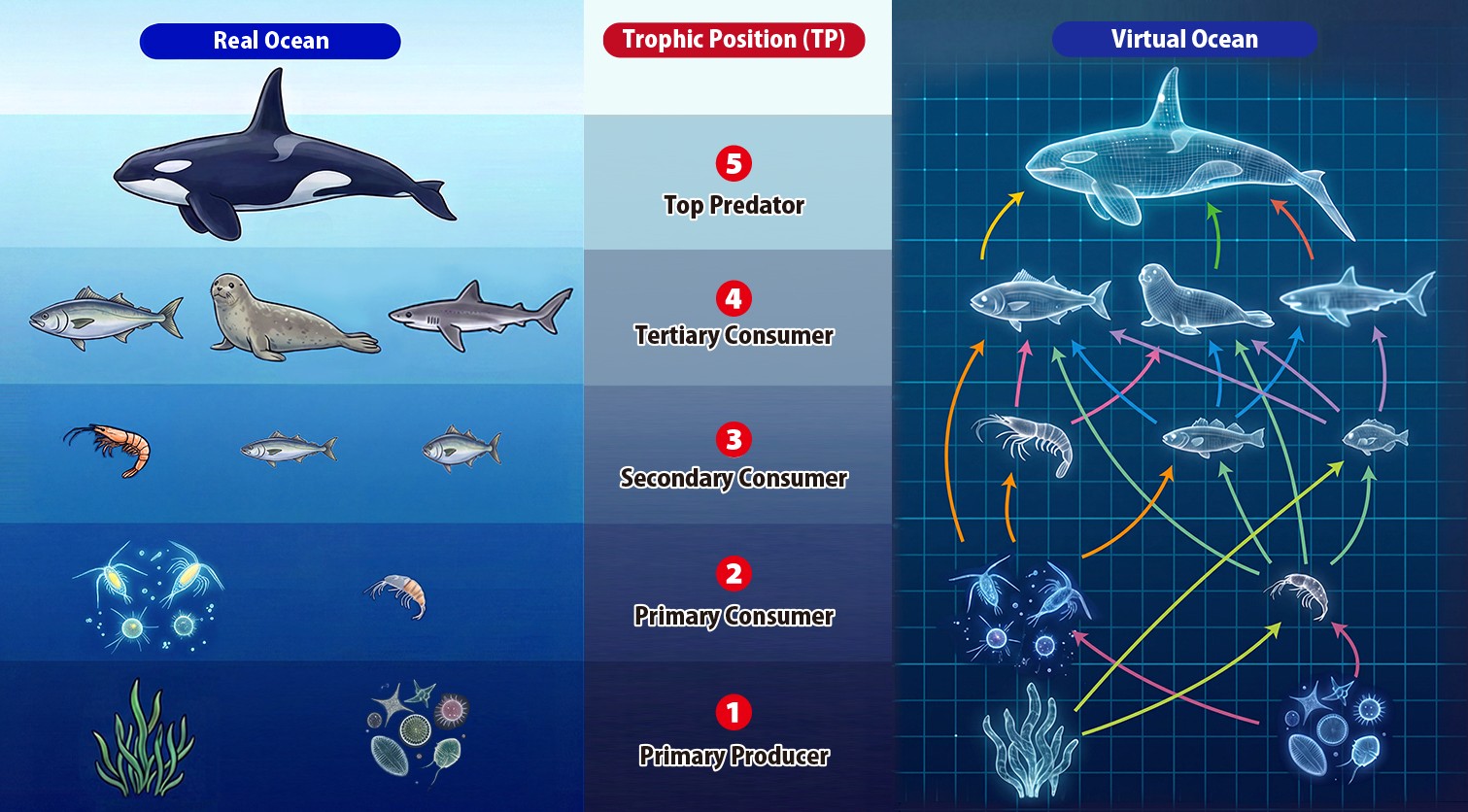
Graphical Abstract (Partially created using generative AI)
These findings were published in Methods in Ecology and Evolution on August 6th. This study was supported by JSPS KAKENHI (22K19857), JST FOREST (JPMJFR2418), and the World Premier International Research Center Initiative (WPI), an initiative launched by the Ministry of Education, Culture, Sports, Science and Technology (MEXT).
Ettore Barbieri1,2, Naoto F. Ishikawa3
- Center for Mathematical Science and Advanced Technology (MAT), Research Institute for Earth and Information Sciences (REIS), Japan Agency for Marine-Earth Science and Technology (JAMSTEC)
- Advanced Institute for Marine Ecosystem Change (WPI-AIMEC)
- Biogeochemistry Research Center (BGC), Institute for Earth and Material Sciences (EMS), Japan Agency for Marine-Earth Science and Technology(JAMSTEC)
Contacts
(For this study)
Ettore Barbieri, Senior Researcher, Center for Mathematical Science and Advanced Technology (MAT), Research Institute for Earth and Information Sciences (REIS), JAMSTECNaoto Ishikawa, Senior Researcher, Biogeochemistry Research Center (BGC), Institute for Earth and Material Sciences (EMS), JAMSTEC
(For press release)
Press Office, Business Promotion Department, JAMSTECSocial Engagement Team, WPI-AIMEC