Projected Coastal Sea-Level Changes around Japan under Global Warming Using a High-Resolution Ocean Model —Regional Differences Associated with Changes in the Kuroshio Path—

1. Key Points
- Using ensemble simulations with the high-resolution ocean model COCO on the supercomputer Earth Simulator, a JAMSTEC research team reproduced fine-scale ocean structures around Japan and projected future dynamic sea-level (DSL) changes under global warming.
- The simulations project a northward shift of the Kuroshio Extension associated with changes in surface wind forcing under global warming. As a result, coastal sea levels around Japan are projected to rise by several centimeters more than the North Pacific mean.
- The ensemble simulations indicate that the frequency of the Kuroshio Large Meander decreases under global warming. This change may contribute to regional differences in sea-level rise between the Tokai and Shikoku regions along the southern coast of Japan.
2. Summary
A research team led by Tatsuo Suzuki of the Japan Agency for Marine-Earth Science and Technology (JAMSTEC) used numerical simulations to project future dynamic sea-level changes around Japan under global warming. Using ensemble simulations with the high-resolution ocean model COCO on the supercomputer Earth Simulator, the researchers realistically reproduced the statistical variability of the Kuroshio and Kuroshio Extension and examined in detail how sea level around Japan may change under global warming The results show that a northward shift of the Kuroshio Extension associated with changes in surface wind forcing leads to coastal sea-level rise around Japan that exceeds the North Pacific mean. The simulations also indicate that the frequency of the Kuroshio Large Meander decreases under global warming (Fig. 1), which may contribute to regional differences in sea-level rise between the Tokai and Shikoku regions along the southern coast of Japan. These findings are expected to contribute to improved projections of future coastal sea-level changes around Japan and to a better understanding of the mechanisms underlying regional sea-level variability.
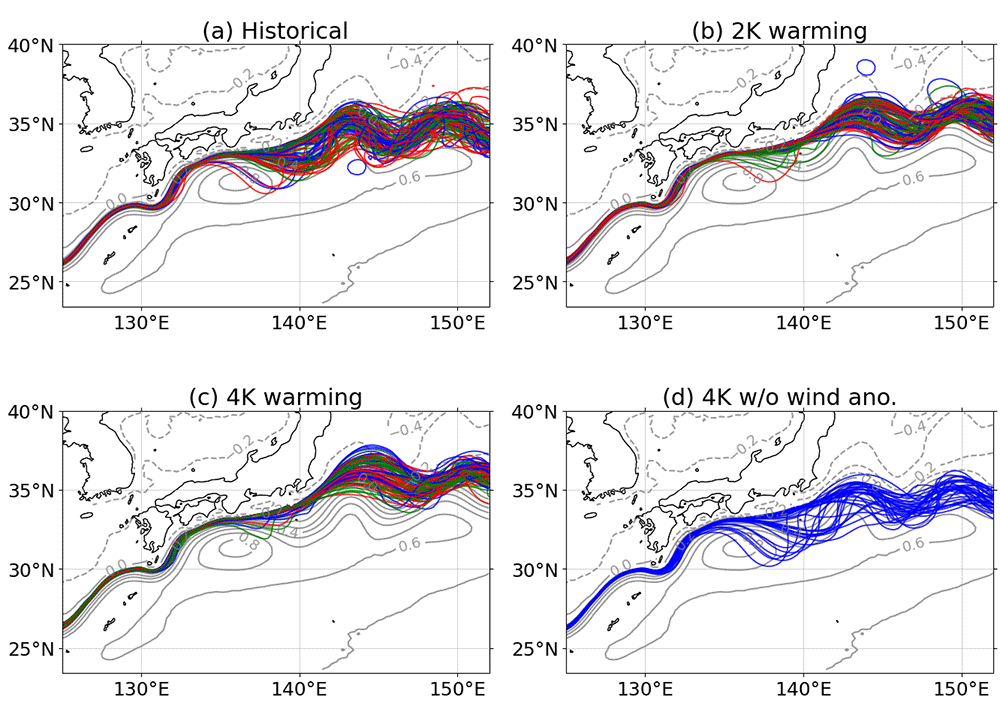
Figure 1. Annual-mean Kuroshio paths defined by the 0.2 m dynamic sea level (DSL) contour. Gray contours indicate the climatological DSL from the historical experiment. For the historical experiment (1981–2010), only the first three members are shown (30 years × 3 members). The 2 K and 4 K warming experiments each include 30 years × 3 members, while the 4 K w/o wind anomaly experiment includes 30 years × 1 member. Colors denote different ensemble members. Gray contours indicate the climatological DSL from the historical experiment.
This study was supported by the Ministry of Education, Culture, Sports, Science and Technology (MEXT) Advanced Studies of Climate Change Projection (JPMXD0722680395) and JSPS KAKENHI Grants JP25K07411 and JP24H00280.
Tatsuo Suzuki, Haruka Yamagami, Masao Kuroki, Takao Kawasaki, Yoshiki Komuro, and Hiroaki Tatebe
Media Contacts
(For this study)
Tatsuo Suzuki, Research Center for Environmental Modeling and Application (CEMA), Research Institute for Global Change (RIGC), JAMSTEC(For press release)
Press Office, Business Promotion Department, JAMSTEC