Learning Biomass Degradation Strategies from Deep-Sea Microbes and Enzymes A deep-sea-inspired chemistry perspective on biological strategies for sustainable biomass utilization

JAMSTEC researchers, in collaboration with Shizuoka University, have proposed a new direction for deep-sea-inspired chemistry by examining biological strategies that enable deep-sea microorganisms to efficiently degrade and utilize recalcitrant biomass. Their review integrates current knowledge of cellulolytic microorganisms and enzymes in the deep sea and identifies biological strategies that may provide design principles for sustainable biomass utilization.
Key Points
- Deep-sea cellulolytic microorganisms and enzymes remain an underexplored source of biological strategies for biomass degradation.
- Deep-sea microbes appear to have evolved efficient strategies for degrading and utilizing recalcitrant biomass under cold, high-pressure, and nutrient-limited conditions.
- The review extends the framework of deep-sea-inspired chemistry beyond physicochemical environments to include biological adaptation strategies for sustainable innovation.
Cellulose, the main structural component of plant cell walls, is the most abundant organic polymer on Earth. Because its molecules are tightly packed into a highly ordered, water-insoluble structure, cellulose is difficult to break down efficiently. Understanding how microorganisms degrade cellulose is therefore important not only for clarifying the global carbon cycle, but also for developing technologies that convert biomass into useful chemicals and materials.
Organic matter produced on land and in the surface ocean can be transported to the deep sea. Because readily degradable components are preferentially decomposed during sinking, the organic matter reaching the deep sea is relatively enriched in recalcitrant components. This raises the possibility that deep-sea microbial ecosystems may have evolved efficient strategies for degrading recalcitrant polysaccharides such as cellulose under cold, high-pressure, and nutrient-limited conditions.
Using SPOT (Surface-Pitting Observation Technology), an ultrasensitive method for visualizing degradation of insoluble polysaccharides, the JAMSTEC team detected weak cellulose-degrading activity and isolated previously unidentified cellulose-degrading bacteria from the deep sea. In a separate in situ experiment, nanofibrillated cellulose deployed in the deep sea was completely degraded after one year, providing direct evidence that microbial degradation of crystalline cellulose can occur under deep-sea conditions.
By integrating research on microbial diversity, molecular adaptation, and marine carbon cycling, the authors reinterpret deep-sea cellulolytic microorganisms as biological systems adapted for the efficient capture, degradation, and utilization of recalcitrant biomass. The review also examines features such as cell-associated cellulases and large multidomain enzymes, which may help microorganisms reduce the loss of enzymes and soluble degradation products in dilute deep-sea environments.
This work extends the emerging framework of “deep-sea-inspired chemistry,” which views the deep sea not only as an object of scientific observation, but also as a source of design principles for sustainable materials, processes, and biotechnology. By incorporating biological adaptation strategies into this framework, the review opens new possibilities for enzyme design and sustainable biomass conversion.
Further integration of genomics, enzymology, structural biology, and surface-sensitive detection technologies is expected to clarify how deep-sea microorganisms degrade recalcitrant polysaccharides under extreme and resource-limited conditions. Reframing the deep sea from an object of observation to a source of design principles may help translate this knowledge into new enzymes and biomass conversion technologies for a circular bioeconomy.
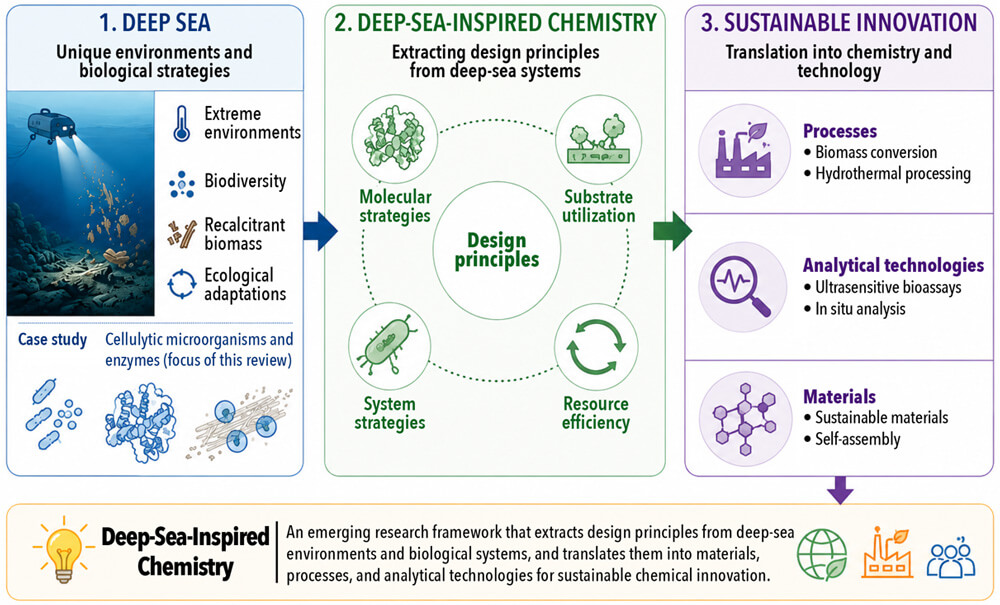
Figure 1. Conceptual framework of deep-sea-inspired chemistry. This framework translates design principles derived from deep-sea environments and biological systems into sustainable innovation in processes, analytical technologies, and materials. In this review, deep-sea cellulolytic microorganisms and enzymes are presented as a representative case study illustrating how biological strategies that have evolved in the deep sea can provide design principles for sustainable biomass utilization.
Mikako Tachioka, Mikiko Tsudome, Akihiko Nakamura, and Shigeru Deguchi (corresponding author)
This work was supported by JSPS KAKENHI (grant number JP23K14000) and JST CREST (grant number JPMJCR21L4).
Contacts
(For this study)
Shigeru Deguchi, Principal Researcher, Institute for Extra-cutting-edge Science and Technology Avant-garde Research of Life (X-star), JAMSTEC(For press release)
Press Office, Business Promotion Department, Planning Division, JAMSTEC