Lack of Particle-Level Size Data Limits Comparability in Marine Microplastic Research - Review of 1,431 studies over more than two decades finds that only 2% reported the size of individual particles -










University of Siena
Aotearoa Blue Ocean Research
Consiglio Nazionale delle Ricerche-Istituto di Scienze Marine
British Antarctic Survey
University of Bayreuth
Incheon National University
Instituto del Mar del Peru
Instituto de Ciencias del Mar-CSIC
Scripps Institution of Oceanography
East China Normal University
1. Key points
- An international research team reviewed 1,431 scientific papers on marine microplastics *1 published between 2004 and 2026 and found that 98% did not report the exact size of individual particles, despite particle size being routinely measured. Seventy-two percent grouped particles into broad size classes, 13% reported only an overall size range such as minimum and maximum values, and another 13% provided no size information. Only 2% reported particle-level size data.
- Particle size is a fundamental property of microplastics because it affects how particles move through the ocean, how rapidly they sink, how they are transported by currents, whether they aggregate with other particles, and whether they are taken up by organisms or transferred into body tissues. However, when data are reported only in broad categories such as 20–100 µm or 100–500 µm, the size of individual particles are lost. This limits regional and long-term comparisons, transport and accumulation modeling, and assessments of ecological impacts.
- The research team recommends that future microplastic studies retain and publicly share particle-level size measurements as raw data. At a minimum, the maximum Feret diameter*2—the longest dimension of a particle—should be reported for every analyzed particle. Particle-level measurements make it possible to construct accurate Particle Size Distributions (PSDs)*3, which describe how particle abundance varies with size. This would allow datasets generated using different analytical methods to be compared and integrated along a common particle-size axis.
Microplastics
Plastic particles ranging in size from 1 µm to less than 5 mm. One micrometer is one-thousandth of a millimeter. See also Figure 1.
Feret diameter
The distance between two parallel lines placed on opposite sides of a particle. As the orientation of the lines is changed, the largest measured distance is called the maximum Feret diameter and the smallest the minimum Feret diameter.
Particle Size Distribution (PSD)
A representation of how particle abundance varies across a range of particle sizes. By normalizing particle counts or other quantities by the particle size, datasets based on different measurement ranges can be compared more consistently.
2. Overview
Shiye Zhao, Senior Researcher, and Ryota Nakajima, Program Director, at the Japan Agency for Marine-Earth Science and Technology (JAMSTEC; President: Tomohiko Kawamura), together with collaborators from 11 institutions in 10 countries, conducted a comprehensive review of how particle size has been recorded and reported in marine microplastic research.
The team examined 1,431 scientific papers published between 2004 and 2026 that investigated microplastics in marine water samples. They found that only 2% of the studies reported measured sizes for individual particles. In the remaining 98%, particle-level size information was not made available in a form that could later be reused.
Particle size is not simply a descriptive characteristic of microplastics. It is one of the fundamental properties governing how long particles remain suspended in seawater, whether they sink to the seafloor, whether they become incorporated into marine snow, and whether they are taken up by organisms.
Nevertheless, many studies currently report microplastic abundance in broad size classes, such as 20–100 µm or 100–500 µm, rather than reporting the size of each particle. Once individual particles have been grouped in this way, their original size information is lost. The data therefore cannot later be reclassified using different size boundaries or restricted to a size range shared by multiple studies.
Comparisons are further complicated by differences in sampling and analytical methods. Studies may use different nets, filters, or instruments, and consequently differ in the smallest particles they can reliably collect or detect. A method capable of detecting smaller particles will generally recover more particles. Therefore, differences in reported particle abundance may reflect differences in analytical capability rather than genuine differences in the marine environment.
To address this problem, the research team recommends that measurements of individual microplastic particles be collected and shared as raw data. At a minimum, the maximum Feret diameter of every particle should be recorded, together with the measurement method and the smallest size that can be reliably detected. Particle-level data would allow researchers to extract common size ranges from different datasets and compare them on a consistent basis, regardless of the size classes originally used.
Such data can also be used to construct Particle Size Distributions, or PSDs, which describe the relationship between particle size and abundance. PSDs provide a common framework for comparing and integrating datasets generated using different analytical methods.
Recording the size of every particle is a practical step that can be implemented immediately. The research team proposes that making particle-level size reporting a common practice would be an important first step toward making marine microplastic datasets worldwide more comparable and reusable.
The study was published publication as an Opinion article in the Proceedings of the National Academy of Sciences of the United States of America (PNAS) on October 21, 2026.
This work was supported by SCOR Working Group 174 (SPASS) through the national committees of the Scientific Committee on Oceanic Research (SCOR), a U.S. National Science Foundation grant to SCOR (OCE-2513154), and JSPS KAKENHI Grant Number 25K03259.
Shiye Zhao1, Luisa Galgani2, Karin Kvale3, Giuseppe Suaria4, Ryota Nakajima1 , Clara Manno5, Martin G. J. Löder6, Seung-Kyu Kim7, Nan Wu5, Sara Purca8, Cristina Romera-Castillo9, C. Anela Choy10, Lixin Zhu11,
- Institute for Earth and Materials Sciences (EMS), Japan Agency for Marine-Earth Science and Technology (JAMSTEC), Yokosuka, 237-0061, Japan
- Department of Biotechnology, Chemistry and Pharmacy, University of Siena, Siena, 53100, Italy
- Aotearoa Blue Ocean Research, Lower Hutt, 5013, New Zealand
- Consiglio Nazionale delle Ricerche-Istituto di Scienze Marine (CNR-ISMAR), Pozzuolo di Lerici, 19032, Italy
- British Antarctic Survey, Cambridge, CB3 0ET, UK
- Animal Ecology I, BayCEER, University of Bayreuth, Bayreuth, 95440, Germany
- Department of Marine Science, Incheon National University, Incheon, 22012, Republic of Korea
- Instituto del Mar del Peru (IMARPE), Callao, 07021, Peru
- Instituto de Ciencias del Mar-CSIC, Barcelona, 08003, Spain
- Scripps Institution of Oceanography, University of California San Diego, La Jolla, CA, 92093, USA
- State Key Laboratory of Estuarine and Coastal Research, East China Normal University, Shanghai, 200241, China
3. Background
A growing body of research has shown that plastics and microplastics are widely distributed throughout the ocean and other aquatic environments (Figure 1). The legacy plastics that already present in the environment, continues to fragment into smaller pieces. As a result, the abundance of microplastics may continue to increase even if the production of new plastics and the release of plastic waste into the environment are reduced.
Particle size is critical to understanding the fate and effects of microplastics. It influences sinking speed, transport by ocean currents, aggregation with other particles, uptake by organisms, and transfer into body tissues.
Accurate comparisons among regions and across time are essential for determining whether measures to reduce plastic pollution are working and the environment exposure concentrations to assess the ocean health. Yet reported microplastic concentrations in the ocean water column—the water body between the sea surface and the seafloor—range from approximately 10-4 to 104 particles per cubic meter, spanning about eight orders of magnitude.
Some of this variability reflects genuine environmental differences. However, differences in sampling and analytical methods, including the range of particle sizes that each method can detect, also contribute substantially.
Methods capable of detecting smaller particles tend to report higher particle abundances. Therefore, simply comparing the number of particles per cubic meter may result in a comparison of measurement capabilities rather than environmental conditions.
Particle-level size information provides a way to overcome this problem. For example, if one study measures particles larger than 10 µm and another measures particles larger than 50 µm, the two studies can still be compared using only particles larger than 50 µm—provided the size of every individual particle has been retained.
By contrast, if the first study reports only a single size category of 10–50 µm, it is impossible to determine afterward which particles were larger than 50 µm. But particle abundance larger than 50 µm can be reasonably predicted via the modelled PSD. Therefore, reporting the size of individual particles is essential if we hope to compare and reanalyze the current datasets by constructing PSD.
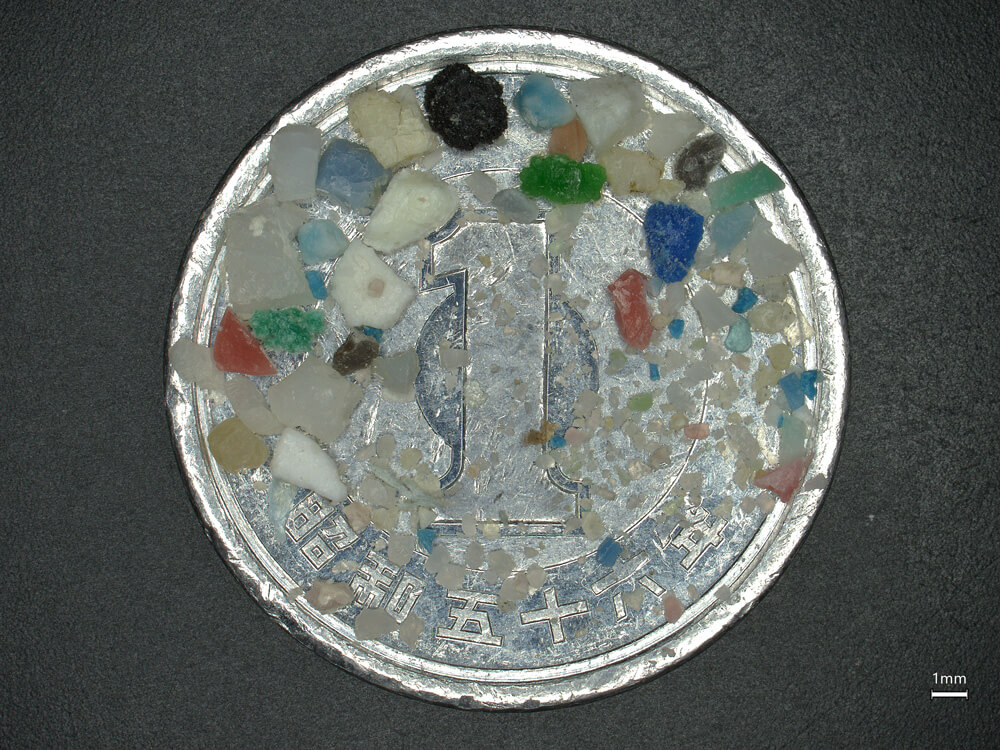
Figure 1. Microplastics of different sizes. Microplastics occur across a wide range of sizes, and particle size strongly affects how they move through the ocean, interact with marine ecosystems, where they ultimately accumulate, and what environmental impacts they may have. Detailed particle-size information has not been reported consistently in previous studies. Recording the size of every particle is therefore important for understanding and managing microplastic pollution. The photograph shows microplastics collected from the North Pacific during JAMSTEC research vessel Mirai cruise MR21-06, placed on a Japanese one-yen coin.
4. Results
Only 2% of studies reported particle-by-particle size data
The research team classified 1,431 marine microplastic studies published between 2004 and 2026 according to how particle size was reported. Seventy-two percent of studies reported particle abundance using several broad size classes. Thirteen percent reported only an overall size range, such as minimum and maximum sizes, and another 13% provided no size information. Only 2% reported the measured size of each particle (Figure 2).
Size-class reporting can indicate, for example, how many particles were found between 20 and 100 µm. However, it does not preserve the actual size of each particle within that range. Because the boundaries of size classes vary among studies, even studies examining similar marine environments cannot be compared directly. Once particle-level size information has been discarded, the data cannot later be integrated into the model of particle size distribution, restricted to a common size range, or reanalyzed under harmonized conditions.
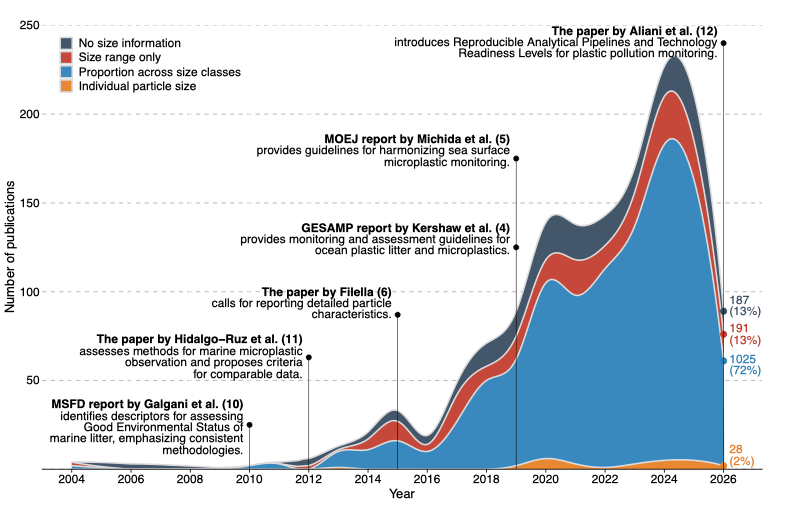
Figure 2. How particle size is reported in marine microplastic studies. A total of 1,431 marine microplastic studies published between 2004 and 2026 were classified according to their reporting of particle size. Seventy-two percent of studies (blue) reported particles in broad size classes. Only 2% (orange) reported the size of each individual particle. Thirteen percent (red) reported only an overall size range, such as minimum and maximum values, while another 13% (black) provided no particle-size information.
Particle size is fundamental to the fate of microplastics in the ocean
Particle size is one of the key factors governing how microplastics move through seawater. For very small particles measuring only a few micrometers or less, Brownian motion caused by collisions with water molecules becomes increasingly important. For larger particles, gravitational settling, buoyancy, and transport by ocean currents play relatively greater roles.
Particle size also strongly influences whether microplastics become incorporated into aggregates composed of organic matter and other materials. In a previous analysis of more than 6,000 interactions between microplastics and aggregates, 97% of particles smaller than 20 µm became incorporated into aggregates, compared with only 9.7% of particles larger than 162 µm. This suggests that even relatively modest differences in particle size may strongly influence whether microplastics remain suspended independently or sink together with other particles.
Sinking rates can also vary dramatically with particle size. Theoretical calculations indicate that a 1-mm nylon particle coated with a 5-µm-thick layer of diatoms could sink more than 1,500 meters per day. By contrast, a 25-µm nylon particle is estimated to sink only about 2.9 meters per year.
Actual sinking rates depend on many factors, including polymer type, density, particle shape, biofouling, and surrounding seawater conditions. Nevertheless, this comparison illustrates how strongly particle size can influence residence time in the water column and the ultimate fate of microplastics.
Particle size also influences biological uptake and tissue translocation
Particle size also affects whether microplastics can be taken up by organisms. Relatively large microplastics generally remain in the digestive tract, whereas particles smaller than 80 µm could move into tissues. The likelihood of such translocation has been reported to increase as particle size decreases. Understanding ecological effects therefore requires more than simply knowing how many microplastic particles are present. It is also important to know how large each particle is.
Particle-level data make it possible to construct Particle Size Distributions
The research team emphasizes the importance of recording and retaining the exact size of each microplastic particle and using those size data to construct accurate Particle Size Distributions (PSD). A PSD describes how particle abundance varies with particle size. Rather than grouping particles into size categories, it allows researchers to examine more continuously which particle sizes are common and which are rare. Such information is essential for understanding size-dependent processes such as transport, sinking, aggregation, and fragmentation.
At present, many studies summarize particle abundance using predefined size classes such as 20–100 µm or 100–500 µm. Because the boundaries of these categories differ among studies, direct comparison is difficult. The apparent form of a PSD may also change depending on where the boundaries between size classes are placed.
If particle-level measurements are retained, datasets are no longer constrained by the original size categories selected by the researchers. The data can instead be reorganized later using common size criteria.
With sufficient particle-level data, measurements from different studies and analytical approaches could also be combined to reconstruct PSDs over a broader size range. This would provide a more consistent basis for comparing marine microplastic distributions among different ocean regions and measurement techniques.
Particle shape, density, and other properties are also important determinants of microplastic behavior. However, particle size is relatively straightforward to measure and is a basic characteristic addressed in nearly all microplastic studies. The research team therefore argues that retaining particle-by-particle size information should be a priority.
5. Future Outlook
To improve the comparability and long-term value of marine microplastic data, the research team makes four recommendations.
5-1. Publish particle-level size measurements as raw data
Scientific journals and research funding agencies should encourage researchers to make the measured size of every analyzed plastic particle available as raw data.
At a minimum, the maximum Feret diameter—the longest dimension of the particle—should be recorded for every particle. Where possible, additional measurements such as particle area and perimeter should also be retained.
These measurements could also help convert number-based PSDs into mass-based PSDs, improving estimates of the total mass and fate of plastics in the ocean.
5-2. Report the measurement method and detection limit
Researchers should report not only how particle size was measured, but also the smallest particle size that the method can reliably detect.
Without this information, an apparent decrease in the abundance of small particles cannot be distinguished from a methodological limitation in which the instrument simply fails to detect particles below a certain size.
5-3. Introduce particle-level quality control in public databases
Several important public databases for microplastic research are already in operation, including the Japanese Ministry of the Environment’s Atlas of Ocean Microplastics (AOMI), the U.S. National Oceanic and Atmospheric Administration’s NCEI Marine Microplastic Database, and the European Marine Observation and Data Network (EMODnet) Marine Litter Database.
These databases play an important role in bringing together and integrating observations from around the world.
However, most currently focus on data summarized at the study or sample level. Systems for storing, sharing, and quality-checking standardized particle-level size data are not yet sufficiently developed.
The research team therefore recommends establishing mechanisms that allow the size of individual particles to be registered as raw data together with essential metadata, including the measurement method and minimum reliably detectable size.
The team also highlights the need for expert quality-control procedures to confirm that particle-level datasets meet agreed standards.
5-4. Enable raw data to be added to previously published studies
Authors of previously published papers may still retain particle-level size measurements that were not included in the original publication.
Mechanisms should be established to allow these data to be released formally as supplementary or linked datasets.
By assigning persistent digital identifiers to files such as CSV or JSON datasets and linking them directly to the original publication, historical observations could be reused in future comparative and integrated analyses.
Retaining the size of each individual particle is more than a change in reporting practice. Particle size can serve as a common axis linking information on polymer type, shape, density, chemical composition, and other characteristics. This would provide a stronger foundation for understanding how microplastics are transported, where they accumulate, and how they affect marine organisms and ecosystems.
It is unrealistic to expect all research groups worldwide to immediately standardize their sampling methods and analytical instruments. Recording the size of every particle that has already been measured, however, can begin immediately.
As particle-level reporting improves alongside broader efforts to standardize sampling, analysis, and quality control, marine microplastic datasets from different regions and research groups will become easier to compare and integrate. This will strengthen the scientific basis for assessing long-term changes in marine plastic pollution and evaluating the effectiveness of mitigation measures.
Contacts
(For this study)
Shiye Zhao and Ryota Nakajima, Environmental Substances and Materials Research Program, Research Institute for Earth and Materials Sciences, JAMSTEC(For press release)
Press Office, Press Office, Business Promotion Department, Planning Division, JAMSTEC