One thousand years of phytoplankton growth in the Antarctic Peninsula: exploring the link between the atmosphere and the ocean through chlorophyll a preserved on the seafloor

Key Findings
- An international research team led by JAMSTEC has successfully extracted fossilized molecules of the photosynthetic pigment chlorophyll a*1 from deep-sea sediments collected in the Southern Ocean, precisely measuring their concentration as well as their carbon and nitrogen stable isotope ratios*2. Based on these findings, the team has reconstructed fluctuations in phytoplankton growth periods, production rates, and nutrient utilization rates over the past 1,000 years.
- During the Medieval Warm Period*3 (980–1250 CE), phytoplankton populations grew rapidly in spring, whereas at the onset of the Little Ice Age*4 (1420–1580 CE), their growth was suppressed. These changes were closely linked to the north-south shifting of an oceanic front*5, driven by atmospheric circulation in the Southern Hemisphere.
- This study demonstrated that the isotopic records of molecular fossils derived from photosynthesis preserved on the seafloor can capture the response of marine ecosystems to past climate change, serving as a crucial tool for deciphering the interconnections between the atmosphere, the ocean, and the biosphere.
Chlorophyll a
A molecule used by phytoplankton to harvest light energy, which is then employed to fix carbon dioxide into organic molecules. In the marine environment, this molecule is synthesized exclusively by phytoplankton.
Stable Isotope Ratios of Carbon and Nitrogen
Isotopes are nuclides of the same element that possess different masses. In nature, carbon typically exists as 12C (mass number 12), with an approximately 1.1% admixture of 13C; similarly, nitrogen typically exists as 14N, with a slightly less than 0.4% admixture of 15N. Because these isotopes have distinct physicochemical properties, the rates at which they are incorporated into biochemical reactions vary, and analyzing their ratios allows for the estimation of past phytoplankton growth rates and the efficiency of nutrient utilization.
Medieval Warm Period and Little Ice Age
The Medieval Warm Period (980–1250 CE) and the Little Ice Age (1420–1850 CE) are broad climatic periods, representing climate fluctuations that occurred across various regions of the globe. In the Antarctic Peninsula, conditions were warmer than average during the Medieval Warm Period, while the Little Ice Age was characterized by colder conditions.
Oceanic Front
Refers to the boundary between two water masses with different characteristics in the ocean.
The Southern Ocean plays a crucial role in the carbon cycle. It regulates the exchange of carbon dioxide (CO2) between the atmosphere and the ocean, and helps to store vast quantities of carbon into the deep ocean. A key mechanism in this transport is the "biological pump," whereby the carbon initially captured by phytoplankton through photosynthesis is carried into the deep ocean as the remains of these organisms and the fecal matter of animals form "marine snow" and sink. Accurately determining how the seasonal timing and growth speed of phytoplankton development varied throughout past warm and cold periods provides important insights for understanding how marine ecosystems will respond to future climate change, and how such changes might affect the carbon cycle. Although various analytical approaches have been attempted, a definitive solution has remained elusive.
In this study, fossilized molecules of the photosynthetic pigment chlorophyll a found in seafloor sediments near the Antarctic Peninsula were used to investigate phytoplankton productivity over the past 1000 years, as well as the underlying changes in the atmosphere and ocean.
An international research team including Aymeric Servettaz (Research Institute for Global Change), Yuta Isaji (Institute for Earth and Materials Sciences), Nanako Ogawa (Institute for Earth and Materials Sciences), and Naohiko Ohkouchi (Institute for Earth and Materials Sciences) from the Japan Agency for Marine-Earth Science and Technology (JAMSTEC) has successfully measured the concentration and carbon/nitrogen isotopic composition of chlorophyll a preserved in a 4.5-meter-long sediment core. The core was collected at a depth of 1300 m in the Bransfield Strait, near the Antarctic Peninsula. By employing an ultra-sensitive analytical technique developed at JAMSTEC, the team was able to conduct these measurements for the first time in a sediment core, a significant achievement, given that such fossilized chlorophyll a molecules exist only in extremely scarce quantities.
The carbon and nitrogen isotopic composition of chlorophyll a records phytoplankton growth rates and nutrient utilization. By combining this data with information on water temperature and sea-ice conditions, they reconstructed the fluctuations in phytoplankton production in terms of total output and seasonal timing, from the late 10th century through the latter half of the 19th century. The results reveal that the timing of the phytoplankton growing season and the total production shifted in response to past climate changes (see Figure 1). During the Medieval Warm Period (980–1250 CE), phytoplankton growth was active as early as spring. Thereafter (1250-1420 CE), the growth period shifted toward the summer months, attested by the high nutrient utilization rates and increased presence of pigment degradation products (catabolic products). During particularly cold intervals like the onset of the Little Ice Age (1420–1580 CE), overall phytoplankton growth was suppressed. For the most recent part of the record, phytoplankton growth alternated again between a period of summer plankton growth (1580-1750 CE) and suppressed productivity (1750-1870 CE). The most recent period after 1870 CE could not be recovered due to technical limitations and was not studied.
Near the Antarctic Peninsula, an oceanic front named “Peninsula Front” forms a boundary between warm water in the north, favorable to phytoplankton growth, and cold water in the south, where growth is slowed down. The research team attributed the fluctuations in phytoplankton activity to the north-south shifting of the Peninsula Front. Specifically, the variation depends on whether warm seawater expanded into the study area between spring and summer, or whether cold seawater persisted there throughout the year. The following interpretations were given (see also the corresponding map in the lower part of Figure 1):
• Pattern 1: When the oceanic front is positioned further south, vertical mixing of the seawater is restricted by a floating lens of warm water. This allows phytoplankton to remain in the sunlit surface layer, where they can thrive and multiply.
• Pattern 2: If the oceanic front passes over a sampling site during the growing season, the mixing conditions in the surface layer will shift between spring and summer, allowing for phytoplankton to develop only in the later part of the season at that site.
• Pattern 3: When the oceanic front is located further north, the colder seawater undergoes deep mixing, which limits the amount of light available to the phytoplankton and suppresses their growth.
By comparison with the reported history of atmospheric circulation, these shifts in oceanic fronts match the timing of changes in atmospheric conditions, such as the strength of the Southern Hemisphere westerly winds. It suggests that the wind can influence the position of the oceanic front and local phytoplankton growth.
This study demonstrates that the isotopic records of fossilized photosynthetic pigments preserved on the seafloor can reveal how marine ecosystems responded to past climate change, as well as the underlying interconnections between the atmosphere, the ocean, and the biosphere. The findings presented here provide a foundation for understanding how marine ecosystems and the carbon cycle in the Southern Ocean may respond to future climate change. As warming continues in this region and the influence of westerly winds intensifies, it is possible that spring phytoplankton blooms could become more vigorous due to a southward shift of the Peninsula Front. Moving forward, the research team intends to analyze chlorophyll a molecular fossils in other regions, to investigate for example how glacial melting influences the growth of phytoplankton.
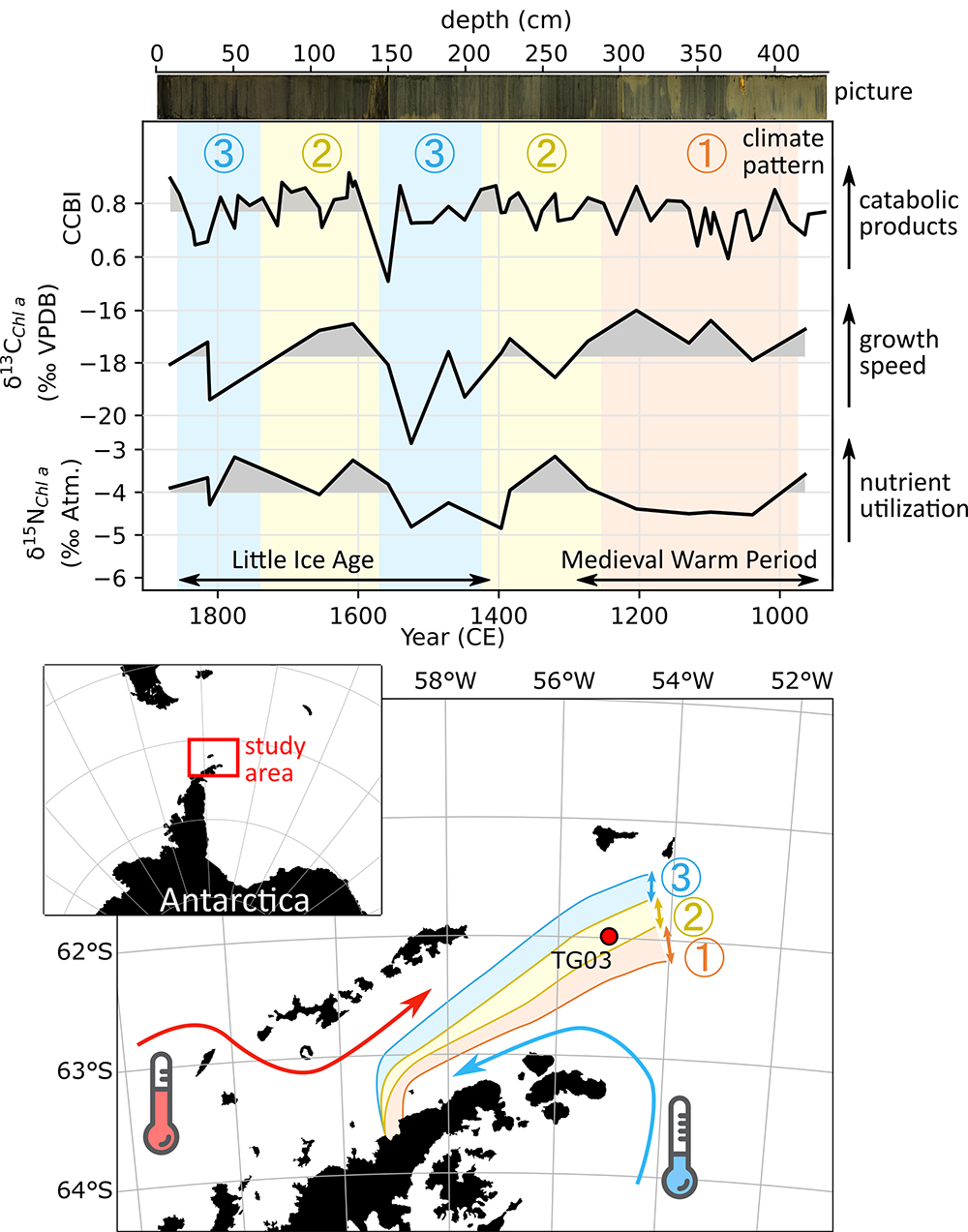
Figure 1. Changes in phytoplankton activity over the past 1000 years (top), and map illustrating the shifts in an oceanic front that account for these changes (bottom). Based on data such as the carbon and nitrogen isotope ratios of chlorophyll a, we estimated phytoplankton growth rates, nutrient utilization, and the impact of predation by zooplankton. These records can be explained by shifts in the position of an oceanic front, the "Peninsula Front", that separates relatively warmer waters to the north from colder waters to the south. The red circle (TG03) indicates the sediment sampling site. Climate Pattern 1: the front was positioned to the south of the sampling site starting in the spring. In the presence of warm seawater, phytoplankton proliferated actively by utilizing abundant nutrients. Pattern 2: the front moved southward across the sampling site between spring and summer, causing phytoplankton to proliferate primarily during the summer. By the time the front reached the sampling site, some of the nutrients had already been consumed by phytoplankton growth elsewhere during the spring. Consequently, the proliferation of phytoplankton at the sampling site was likely gradual. Another characteristic is the high proportion of catabolic products, which are generated when phytoplankton are consumed by zooplankton and the chlorophyll a molecules are degraded by the digestion. Pattern 3: The oceanic front remained to the north of the sampling site throughout the spring and summer; although nutrient levels at the site were high, the growth of phytoplankton was suppressed by the cold seawater.
This study was published in the journal Paleoceanography and Paleoclimatology on November 24, 2026. This work was supported by JSPS KAKENHI grant number JP23H00153, the Spanish Ministry of Science, Innovation and Universities projects TASDRACC (grants numbers CTM2017-89711-C2-1P & CTM2017-89711-C2-2P) and AntOcean (grant number PID2021‐126495NB‐C1/2) cofunded with the European Union ERDF, the INSU-CNRS LEFE project SOFT, and the project PHYTOPLANKTON funded by the BNP Paribas Foundation.
Aymeric P. M. Servettaz1, Yuta Isaji1, Cecilia Morales-Ocaña2,3, Manon Sabourdy4,5, Nanako O. Ogawa1, Francisco J. Jiménez-Espejo1,3, Johan Etourneau4,6, Amy Leventer7, Mathilde Bourreau5,8, Marie-Alexandrine Sicre9, Arnaud Huguet9, Carlota Escutia3, Xavier Crosta4, Naohiko Ohkouchi1
- JAMSTEC
- University of Granada
- Andalusian Institute of Earth Sciences
- University of Bordeaux
- French Alternative Energies and Atomic Energy Commission
- École Pratique des Hautes Études
- Colgate University
- École Normale Supérieure
- French National Centre for Scientific Research
Contacts
(For this study)
Aymeric SERVETTAZ, Researcher, Arctic Ocean Environment Research Group, Institute of Arctic Climate and Environment Research, Research Institute for Global Change (RIGC), JAMSTEC(For press release)
Press Office, Business Promotion Department, JAMSTEC