Zooplankton data
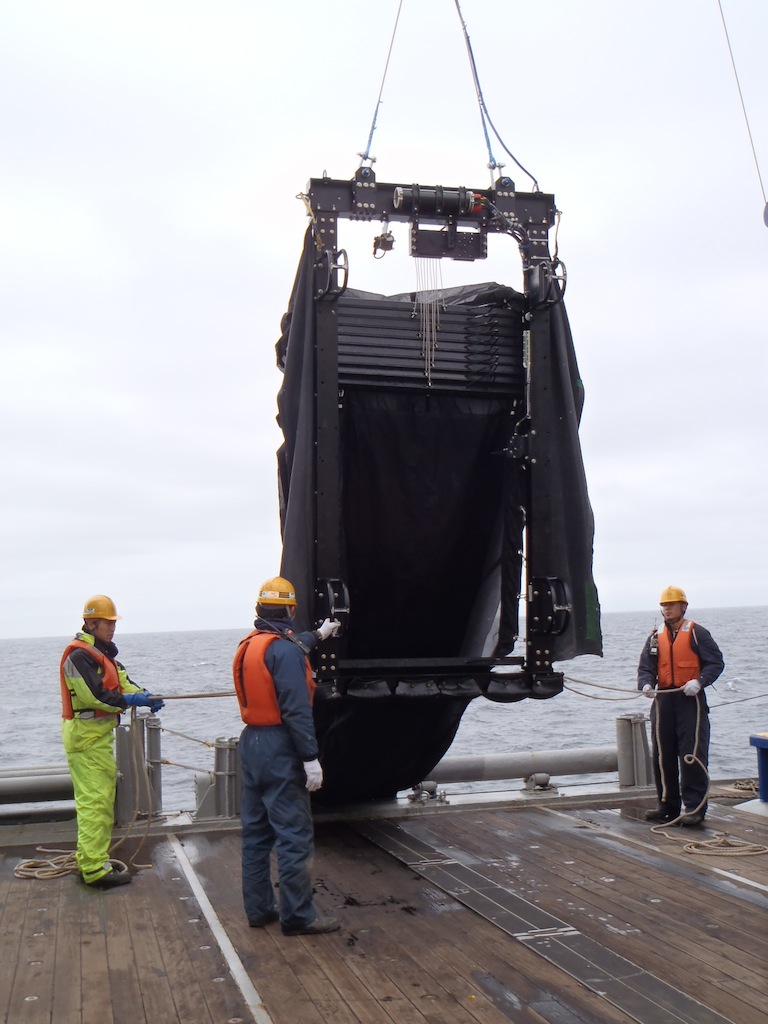
Zooplankton data at stations K2 and S1 (bulk biomass of zooplankton, carbon and nitrogen contents [%] of the bulk zooplankton samples, and the carbon/nitrogen ratios of the bulk zooplankton samples) are based on samples collected with a multiple opening/closing net sampling system (IONESS, SEA Co. Ltd.).
Available cruise ID and period
MR12-02 (Leg1:2012/6/4 ~ 2012/6/24 / Leg2:2012/6/24 ~ 2012/7/12)
MR11-05 (Leg1:2011/6/27 ~ 2011/7/16 / Leg2:2011/7/16 ~ 2011/8/4)
MR11-03(2011/4/14 ~ 2011/5/5)
MR11-02(2011/2/11 ~ 2011/3/9)
MR10-06(2010/10/18 ~ 2010/11/16)
MR10-01(Leg1:2010/1/19 ~ 2010/2/6 / Leg2:2010/2/7 ~ 2010/2/24)
The data are arranged in one MS Excel file at both stations.
Data analysis and format
- Net ID: Sampling gear, IONESS, consisted of a rectangular frame (mouth opening of 1.5 m2) and nine nets (0.33-mm mesh, each net being numbered from 0 to 8). The letter ‘I’ means that the sample was collected with the IONES. Additional numbers indicate the sampling date (yymmdd); a capital letter A or B means the first or second tow in each sampling day, respectively; and a number after a hyphen indicates the net number.
- Stn: name of sampling station, K2 or S1.
- Day or Night: this column indicates day sampling or night sampling.
- Date & Time: sampling date and time in local ship time or UTC.
- Depth: sampling depth (m).
- Filtering volume: the filtering volume of each net was calculated with the following equation: DT x MO x FE, where DT is the distance of each tow (m) estimated with a flow-meter, MO is the average area of the mouth opening (m2), which was estimated by using frame angle data during each tow, and FE is the filtering efficiency (96%), which had been previously measured.
- Dry mass: bulk biomass of zooplankton (g-dry-weight [1000 m3]–1). Collected zooplankton samples were qualitatively divided on board and frozen at −20 °C. After the cruise, the samples were dried (60 °C for 24 h) and weighed at an onshore laboratory.
- C, N contents: carbon (total carbon) and nitrogen contents (%) of the bulk zooplankton samples. The above-mentioned dry samples were pulverized, and the C and N contents were analyzed with a CHN analyzer.
- C/N ratio: carbon/nitrogen ratio of the bulk zooplankton sample (wt : wt).