RESEARCH
Understanding Ocean Environmental Change and Dynamics through Observations
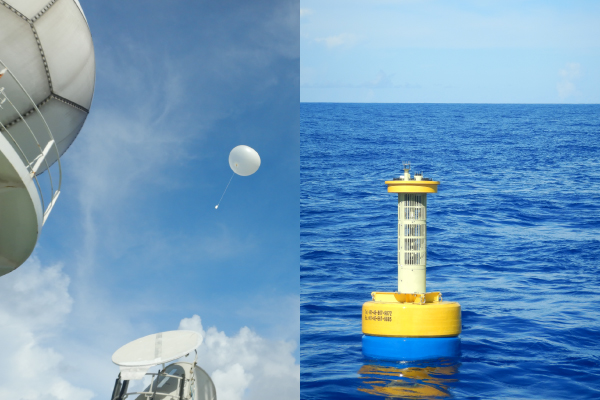
Using research vessels, drifting floats, and moored systems, and by actively leveraging international frameworks, we conduct precise and efficient observations of physical and biogeochemical variability in the ocean environment, as well as exchanges of momentum, heat, and matter between the ocean and atmosphere. We also advance research through the application of state-of-the-art analytical methods.
Through these efforts, we comprehensively investigate the state of the global ocean—from the surface to the deep layers—and its interactions with the atmosphere. This work enhances our understanding of global environmental dynamics, particularly the role of ocean variability in shaping and driving changes in the Earth system.
Integrated understanding of material cycles, ecosystem dynamics, and physicochemical phenomena
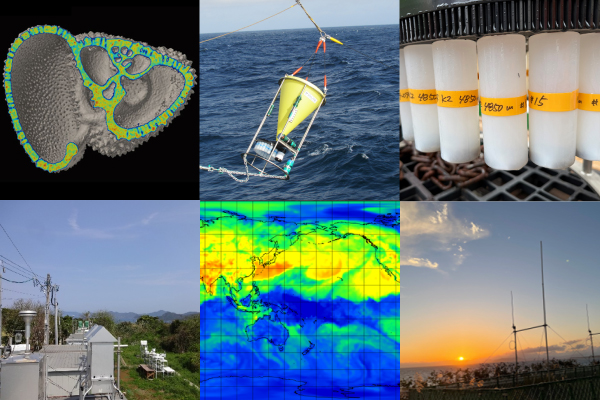
Through the combined use of observations, numerical analysis, and modeling, and by developing new techniques for satellite and field observations and data assimilation, we comprehensively address material cycles and ecosystem dynamics encompassing not only oceans and the atmosphere but also terrestrial areas. Specifically, we focus on carbon budgets and related processes that influence environmental and climate change. We strive to understand the roles and mechanisms of human activities and natural systems affecting these processes. We also enhance our understanding of atmospheric composition changes, biological responses to ocean acidification, and environmental changes in coastal areas like the Tsugaru Strait. We generate insights contributing to environmental and climate change countermeasures and actively disseminate this information.
Elucidating the Mechanisms of Global Environmental Change and Predicting Future Variability Using Numerical Simulation
We contribute to understanding the dynamics of global environmental change by utilizing various numerical models, including Earth system models. We elucidate the complex nature of the Earth system, including the interactions between climate change phenomena occurring at different timescales and the roles each phenomenon plays. Furthermore, through research and development applying our understanding of Earth system mechanisms and phenomena to prediction, we tackle diverse global-scale future projections concerning Earth environmental change, including ecosystems.
Understanding Environmental Change and Dynamics in the Arctic Region
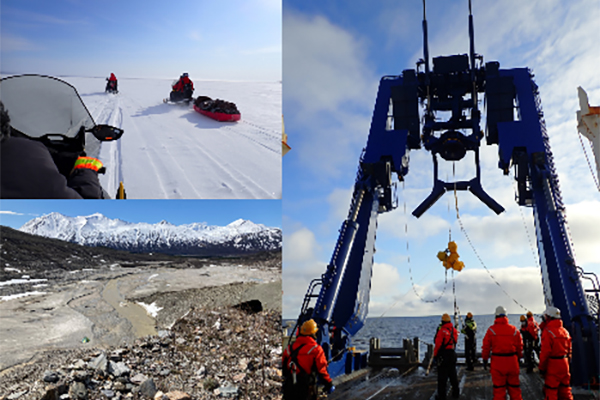
Using the Arctic region—a data gap area where the effects of global warming are most pronounced—as our field, we will acquire and publish data for assessing current conditions and making future predictions. This will be achieved by leveraging observational data obtained through field observations and satellite observations based on various international projects, and by utilizing numerical calculations. This will enhance our understanding of the climate and environmental system, including interactions between the ocean, snow and ice, atmosphere, and land, and clarify the role of the Arctic in the global climate. It will also reveal the Arctic's functions that contribute to global environmental change.