Successful Acoustic Communication Between a Small Underwater Vehicle and an Unmanned Seaplane, and Automatic Water Landing of the Unmanned Seaplane — A Major Step Toward Seamless Marine Surveys Using KAIKU (Sea-Air) Unmanned System —


ShinMaywa Industries, Ltd.
1. Key Points of the Announcement
- Successful direct communication between an underwater vehicle and an unmanned Seaplane: We successfully retrieved observation data from a small underwater vehicle directly to an unmanned seaplane on the sea surface via an acoustic communication device.
- Demonstration of automation technology: We achieved automatic flight and automatic water landing of the unmanned seaplane, confirming the effectiveness of automation technologies for future unmanned marine surveys.
- Improving the efficiency of marine surveys: Utilizing this technology in the innovative "KAIKU (Sea-Air) Unmanned System", which combines an unmanned seaplane and an underwater vehicle, enables continuous underwater surveys and rapid data retrieval. This is expected to dramatically improve survey capabilities in Japan's Exclusive Economic Zone (EEZ) and other areas.
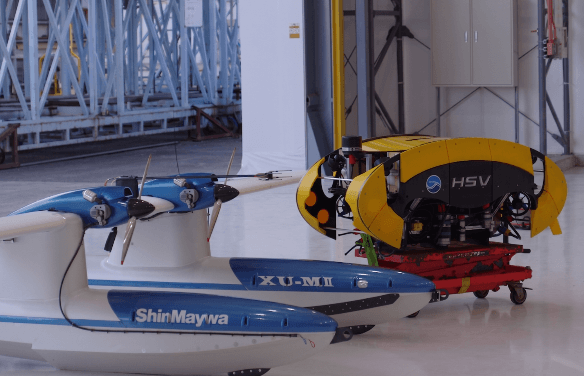
Photo 1: Small underwater vehicle "HSV" and Unmanned seaplane "XU-MII"
2. Overview
A joint research team—led by Tomoya Inoue, Director of the KAIKU Technology Development Center at the Research Institute for Marine Technology and Engineering, Japan Agency for Marine-Earth Science and Technology (JAMSTEC; President: Tomohiko Kawamura), in collaboration with ShinMaywa Industries, Ltd. (ShinMaywa; President & CEO: Takashi Kunihara) — successfully conducted a field test off the coast of Ashiya, Hanshin Port, Hyogo Prefecture, in April 2026. The test utilized the small underwater vehicle "HSV"*1 and the unmanned seaplane "XU-MII"*2.
In this test, the team successfully established acoustic communication*3 between the XU-MII on the sea surface and the HSV conducting underwater observations. The unmanned seaplane XU-MII successfully retrieved data, including seafloor images captured by the HSV, in real time. In addition, the automatic flight and automatic water landing of the XU-MII under real sea conditions were successfully demonstrated.
These results were obtained as part of the research and development project "Development of KAIKU (Sea-Air) Unmanned System for Ocean Observation, Monitoring, and Survey" commissioned to JAMSTEC, ShinMaywa, and partners by the Japan Science and Technology Agency (JST) under the Key and Advanced Technology R&D through Cross Community Collaboration Program (K Program)*4.
The insights gained from this test demonstrate the feasibility of "KAIKU Unmanned System" and hold the potential to make various marine surveys across the vast ocean significantly more efficient and agile.
Small underwater vehicle HSV
A small underwater vehicle owned by JAMSTEC for testing and evaluation.
Approximate dimensions: length 1.4m × width 0.7m × height 0.6m
Weight in air: Approx. 100kg
Maximum diving depth: 200m
Observation equipment: Optical camera (mounted facing downward)
Unmanned seaplane XU-MII
A 1/5 scale unmanned seaplane developed by ShinMaywa for data collection and issue identification.
Dimensions: length 3.86m × width 5.5m × height 1.05m
Propulsion system: Twin engines/propellers
Payload: 10kg or more
Cruising speed: 72km/h
Acoustic communication
Since radio waves are absorbed in the seawater, acoustic waves are used for communication and positioning, except over very short distances. "Communication" refers to the transmission of various data, such as observation data, while "positioning" refers to measuring distance and angle by transmission and reception of known signals to estimate a location. For details, please refer to this website (in Japanese):
https://www.jamstec.go.jp/mesc/j/uatrg/
Key and Advanced Technology R&D through Cross Community Collaboration Program (K Program)
A national program established under the leadership of the Cabinet Office to promote the research, development, and utilization of advanced, critical technologies essential for Japan to secure a firm position in the international community over the medium to long term. For details, please refer to this website (in Japanese):
https://www8.cao.go.jp/cstp/anzen_anshin/kprogram.html.
For details on the R&D project "Development of KAIKU (Sea-Air) Unmanned System for Ocean Observation, Monitoring, and Survey", please refer to this website (in Japanese):
https://www.jst.go.jp/k-program/program/kaiyou1.html
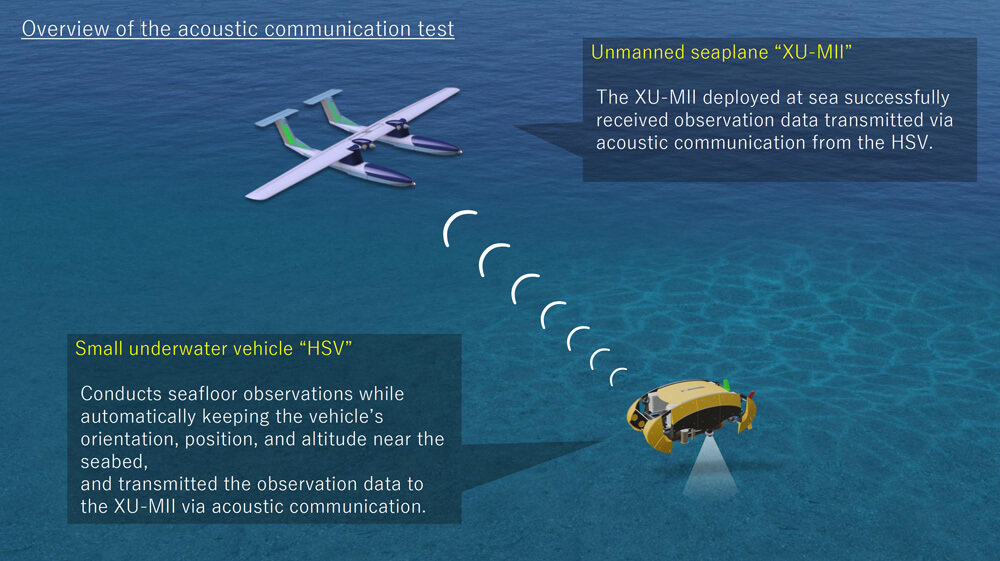
Figure 1: Conceptual diagram of the acoustic communication test
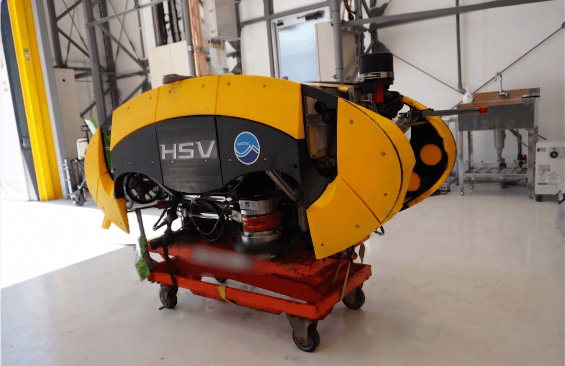
Photo 2: HSV
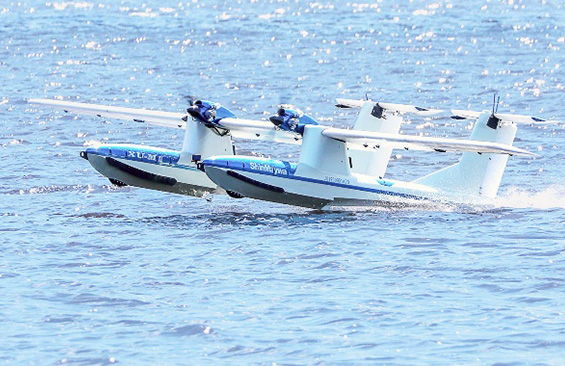
Photo 3: XU-MII

Photo 4: A seafloor image taken and transmitted by HSV
3. Background
In Japan, which possesses the vast EEZ, marine surveys are required across diverse fields, including resource exploration, marine monitoring, information gathering during disasters (such as submarine volcanic eruptions), and underwater searches. To conduct these surveys effectively and safely, an agile survey system utilizing unmanned vehicles that complements or replaces conventional manned vessel operations is essential.
A joint team led by JAMSTEC—with the participation of ShinMaywa IDEA Consultants, Inc., and the National Institute of Maritime, Port and Aviation Technology—is developing technologies for "KAIKU Unmanned System" under the K Program. This system aims to rapidly transport and launch an Autonomous Underwater Vehicle (AUV) to a target ocean area using an unmanned seaplane, and automatically recovers it after the survey is completed. In this initiative, automatic water landing technology for the seaplane and automatic launch and recovery technology for the AUV are positioned as critical factors determining the system's feasibility. Among these, acoustic communication between the seaplane and the AUV plays a core role in data transmission during survey dives and recovery processes.
While this project ultimately plans the development of full-scale vehicles followed by technology demonstration tests, the team is conducting phased technical demonstrations using existing vehicles and scale models. As part of this approach, the test off the coast of Ashiya on April 9, 2026, was conducted, in which the automatic flight and water landing of the XU-MII and real-time data transmission and retrieval via acoustic communication between the XU-MII and the HSV were successfully demonstrated.
4. Results
The following key milestones were achieved in this test:
-
Successful Acoustic Communication and Data Transmission Between XU-MII and HSV:
Around the seafloor at a water depth of approximately 15m, the HSV automatically maintained its position, heading, and altitude while capturing seafloor images. It successfully transmitted the acquired images and vehicle status information in real time to the XU-MII using its onboard acoustic communication device, proving that an unmanned seaplane on the ocean surface can instantly retrieve underwater observation data. - Successful Automatic Water Landing of the XU-MII:
The aircraft achieved a precise automatic water landing via its onboard flight control system*5. This success serves as a foundational technology for automatically landing future demonstration aircraft in open ocean wave environments.
By combining these two achievements, it becomes possible to seamlessly link sea and air unmanned vehicles. For instance, an unmanned seaplane can be deployed to an ocean area to retrieve and relay observation data to operators on land while the AUV continuously maintains its dive and survey operations.
Flight control system
A general term for systems used to control an aircraft's attitude, altitude, and heading. During autonomous flight, the system calculates necessary control surface angles based on sensor data and operates the steering surfaces and thrust actuators.
5. Prospects
This project is currently developing technologies to ensure stable automatic takeoffs and water landings even under adverse wind and wave environments, besides automatic AUV launch and recovery system, AUV weight reduction, high-precision position control, and integrated multi-vehicle operations. In FY2028, the team plans to conduct sea trials using a small-scale prototype KAIKU Unmanned System that integrates these component technologies. By FY2033, the project aims to achieve its final output goals — such as a one-way cruising range of 200 nautical miles and an observation depth of 2,000m — using a full-scale demonstration system, which consists of an approximately 4-meter AUV mounted on an approximately 17.5-meter unmanned seaplane. The insights gained from the recent test will be integrated into ongoing R&D to refine these technologies into highly practical solutions.
Ultimately, the project aims to contribute to safe, efficient marine surveys for Japan as a leading maritime nation by deploying KAIKU Unmanned System and their derivative technologies across diverse fields, including resource exploration, marine infrastructure monitoring, disaster prevention, and underwater search operations.
Contacts
(For this study)
* Japan Agency for Marine-Earth Science and Technology (JAMSTEC)-
Regarding overall research, unmanned underwater vehicles, and acoustic communication:
Tomoya Inoue, Director, KAIKU Technology Development Center, Research Institute for Marine Technology and Engineering -
Press Inquiries:
Press Office, Business Promotion Department, Planning Division
-
Regarding unmanned seaplanes:
Engineering Department, Engineering Division, Aircraft Division -
Press Inquiries:
Brand Communications Strategy Group, , Corporate Planning Division
(For press release)
Press Office, Business Promotion Department, JAMSTEC