Two Independent Primary Magmas Discovered Beneath Hunga Volcano After the 2022 Mega-Eruption — Submarine Dredge Surveys Reveal the True Face of a Giant Submarine Volcano Hidden from Island Surface Studies —



Earth Sciences New Zealand
AIST
Key Findings
- First Submarine Flank Sampling via Dredge Surveys Unveils Hidden Magmas Following the catastrophic January 2022 eruption of Hunga Volcano, international joint research successfully collected "basalt" and "magnesian andesite" samples from the submarine flanks—rocks entirely absent from previous studies of the subaerial island. Petrological analysis revealed that these two distinct primary magmas were generated independently at different depths within the mantle: basalt at approx. 40–50 km and magnesian andesite at a much shallower 15–20 km.
- Validation of Japan's "Nishinoshima Model" ("Continents Born from the Ocean") in the South Pacific The study successfully verified that the "Nishinoshima Model"—a groundbreaking hypothesis proposed by JAMSTEC stating that continent-forming magnesian andesite magma can be generated directly within the shallow mantle of thin oceanic island arcs—applies perfectly to the Tonga arc on the other side of the planet, proving it to be a universal rule of planetary evolution.
- Magma Mixing Implicated in Mega-Eruption; Lessons for Japan's Nishinoshima Volcano The rapid injection and mixing of deep, volatile-rich, high-temperature basaltic magma into a shallow andesitic magma chamber may have driven the unprecedented explosive force of the 2022 eruption. Because Japan's Nishinoshima Volcano shares a highly similar magma system, this discovery suggests that Nishinoshima could experience a similarly catastrophic eruption and caldera formation accompanied by tsunamis in the future, highlighting the critical importance of marine volcanic monitoring.
Basalt
A type of volcanic rock (solidified magma) with a silica content (SiO_2) of 53 weight percent (wt%) or less. Dark in color, basalt is the primary constituent of the Earth’s oceanic crust.
Andesite and Magnesian Andesite
Volcanic rocks with a silica content between 53 wt% and 63 wt% are classified as andesite. The Earth's continental crust has an average composition equivalent to andesite (approx. 60 wt% SiO_2), making it the key to the mystery of continental origins. Magnesian andesite is a unique variety possessing exceptionally high magnesium (Mg) content. Its chemistry indicates that it was generated directly within the mantle without shifting its composition, serving as definitive evidence for the "Nishinoshima Model" (direct continental crust generation from the ocean).
Primary Magma
"Newborn" magma that has just been generated by the partial melting of the Earth’s solid mantle, before undergoing any chemical modification, such as crystal separation or assimilation of surrounding rocks. Even when derived from the same mantle source, the characteristics of primary magmas vary dramatically depending on the generation pressure (depth). High-pressure (deep) melting generates basaltic magma, while low-pressure (shallow) melting directly generates andesitic magma (such as the magnesian andesite magma identified in this study).
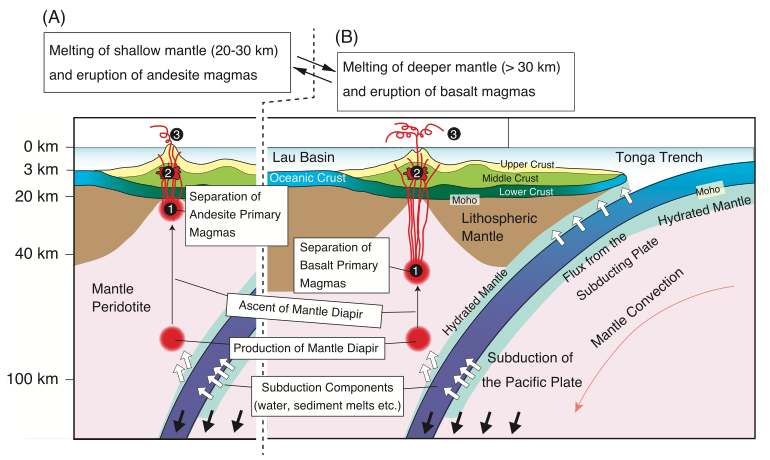
[Figure 1] The Nishinoshima Model proposed at the thin-crusted Ogasawara (Bonin) island arc. In regions with thin crust, andesite magma is generated directly within the mantle, forming the middle crust. The accumulation of this andesitic middle crust at plate collision zones ultimately completes the formation of a new continent.
1. Introduction / Executive Summary
A joint international research team consisting of the Japan Agency for Marine-Earth Science and Technology (JAMSTEC; President Tomohiko Kawamura), Earth Sciences New Zealand, and the National Institute of Advanced Industrial Science and Technology (AIST) has conducted a detailed petrological analysis of the magma plumbing system of Hunga Volcano (Hunga Tonga-Hunga Ha'apai)—the Tongan submarine volcano responsible for the planet-shaking mega-eruption in January 2022.
The subaerial sub-volcanic peaks (Hunga Tonga and Hunga Ha'apai islands) that barely breach the ocean surface were previously thought to erupt exclusively andesitic products. However, by conducting submarine dredge sampling targeting the vast submarine flanks of the volcanic edifice, the research team successfully retrieved previously undiscovered basaltic and magnesian andesite lavas.
Detailed analysis of these seafloor samples overthrew the conventional "single fractionated magma" model. Instead, it revealed that two separate primary magmas—basalt and magnesian andesite, originating from completely different mantle depths—independently sustained this massive volcanic system. The rapid, shallow mixing of these two distinct magmas likely provided the immense force behind Hunga Volcano’s unprecedented explosive power.
This study not only demonstrates the global universality of Japan’s "Nishinoshima Model" in the South Pacific but also underscores the vital socioeconomic importance of marine volcanic monitoring for hazard mitigation in Japan.
This breakthrough was accepted for publication in the British scientific journal Scientific Reports (published by Nature Publishing Group) on June 18, 2026, and was published on July 31, 2026. (This research was supported in part by JSPS KAKENHI Grant Numbers 21H01195 and 23K20899, and the Environment Research and Technology Development Fund [JPMEERF20244M02].)
Yoshihiko Tamura1, Tomoki Sato1, Richard Wysoczanski2, Kevin Mackay3, Iona M. McIntosh1, Qing Chang1, Takashi Miyazaki1, Bogdan S. Vaglarov1, Yasuhiro Hirai4
- JAMSTEC
- NIWA
- Earth Sciences NewZealand
- AIST
2. Background
The January 15, 2022 eruption of Hunga Tonga-Hunga Ha'apai Volcano was one of the largest explosive marine volcanic events of the 21st century, sending atmospheric shockwaves multiple times around the globe and causing widespread tsunamis.
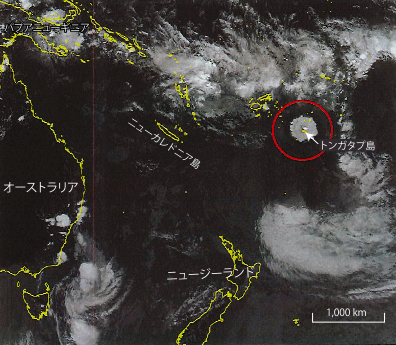
[Figure 2] From the Japan Meteorological Agency (JMA) website. The January 15, 2022 eruption formed a massive plume reaching an altitude of 16 km with a diameter of 500 km. Tongatapu Island, located 65 km away, was completely covered by the volcanic ash plume. The explosion triggered worldwide shockwaves (sonic booms) and tsunamis.
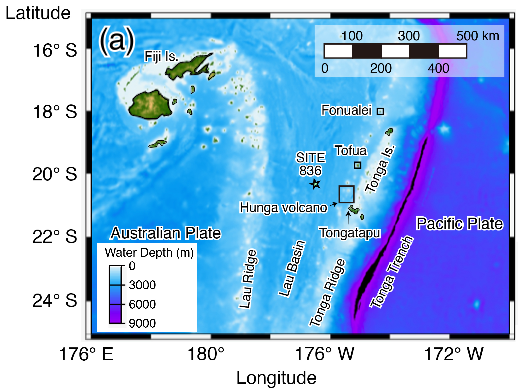
[Figure 3] Diagram showing the subduction of the Pacific Plate beneath the Indo-Australian Plate at the Tonga Trench. Hunga Volcano is located approximately 65 km north-northwest of Tongatapu Island.
Despite global attention, the core question of how this volcano generated such destructive, explosive energy—specifically, how magma was generated and supplied deep underground—remained shrouded in mystery due to its submarine environment.
In 2016 and 2019, JAMSTEC pioneered global volcanology by introducing the "Nishinoshima Model" (Tamura et al., 2016; Tamura et al., 2019), demonstrating that thin oceanic island arcs can bypass traditional continental evolution by generating continent-building andesite magma directly within the shallow mantle. This current study was initiated to test the global universality of this Japanese model at the thin-crusted Tonga arc in the South Pacific.
While post-2022 studies proliferate, they have been strictly constrained to analyzing subaerial rock samples from the sub-volcanic peaks ("the tip of the iceberg"). Investigating the vast submerged flanks through direct seafloor exploration was indispensable to unlocking the volcano's true magmatic provenance and plumbing system. Furthermore, gathering data on such analogous marine volcanoes is a vital national imperative for disaster risk reduction. Given the numerous geological commonalities between Nishinoshima and Hunga Volcano, a similarly violent, caldera-forming eruption accompanied by devastating tsunamis could theoretically occur at Japan's Nishinoshima, heavily emphasizing the urgency of maritime volcanic surveillance.
3. Research Achievements
■ Emergency Submarine Dredge Survey Just Three Months Post-Eruption
The JAMSTEC research group launched a collaborative venture with Earth Sciences New Zealand (formerly NIWA) in 2022. Merely three months after the cataclysmic January blast, an emergency cruise (TAN2206) was deployed from April to May 2022 utilizing the research vessel (R/V) Tangaroa.
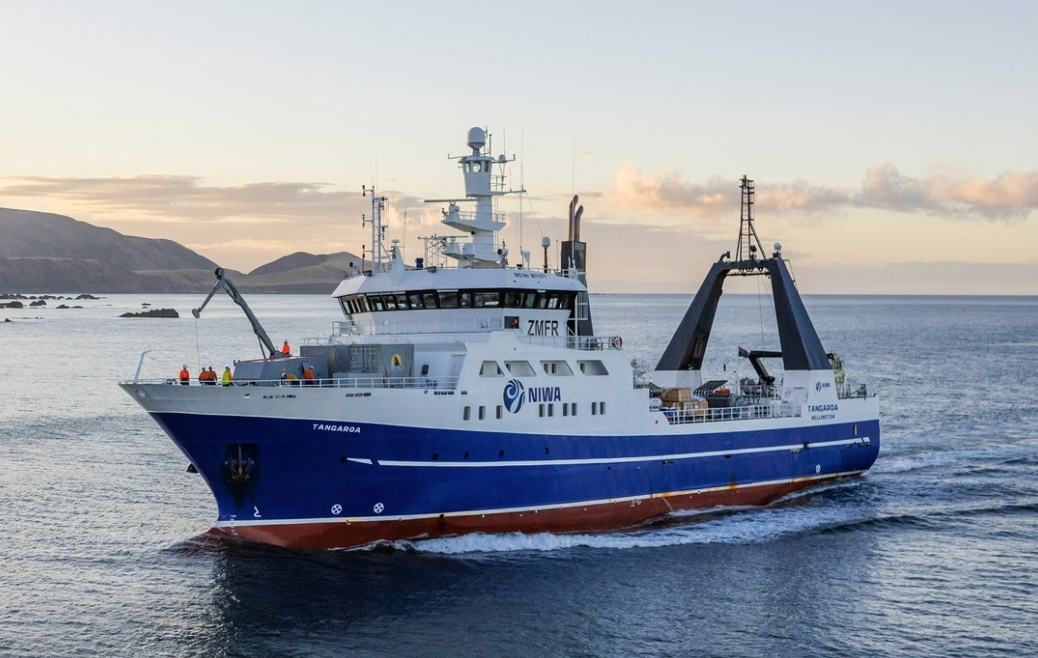
「R/V Tangaroa」photo by Dave Allen provided by NIWA
Using submarine dredge sampling (a method of scraping seafloor rocks into a towed iron mesh basket), the team successfully captured the first massive suite of volcanic rocks from Hunga's submerged slopes. Advanced chemical and isotopic analysis at JAMSTEC revealed that basalt and magnesian andesite—entirely absent from the subaerial island peaks—blanketed the underwater flanks.
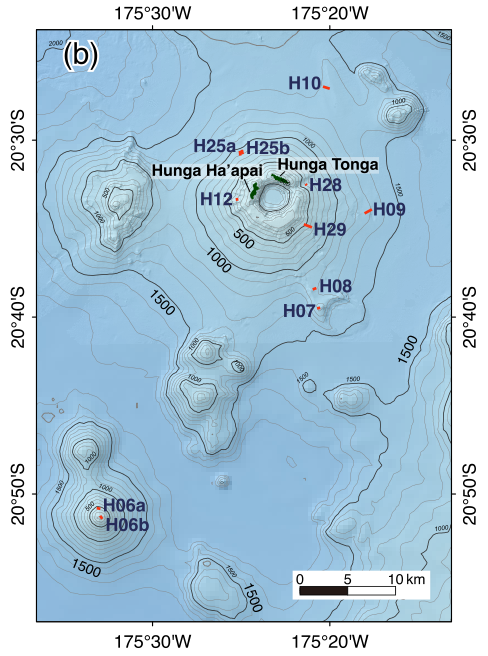
[Figure 4] Map illustrating the specific submarine dredge locations where rock samples were retrieved within the Hunga volcanic area.
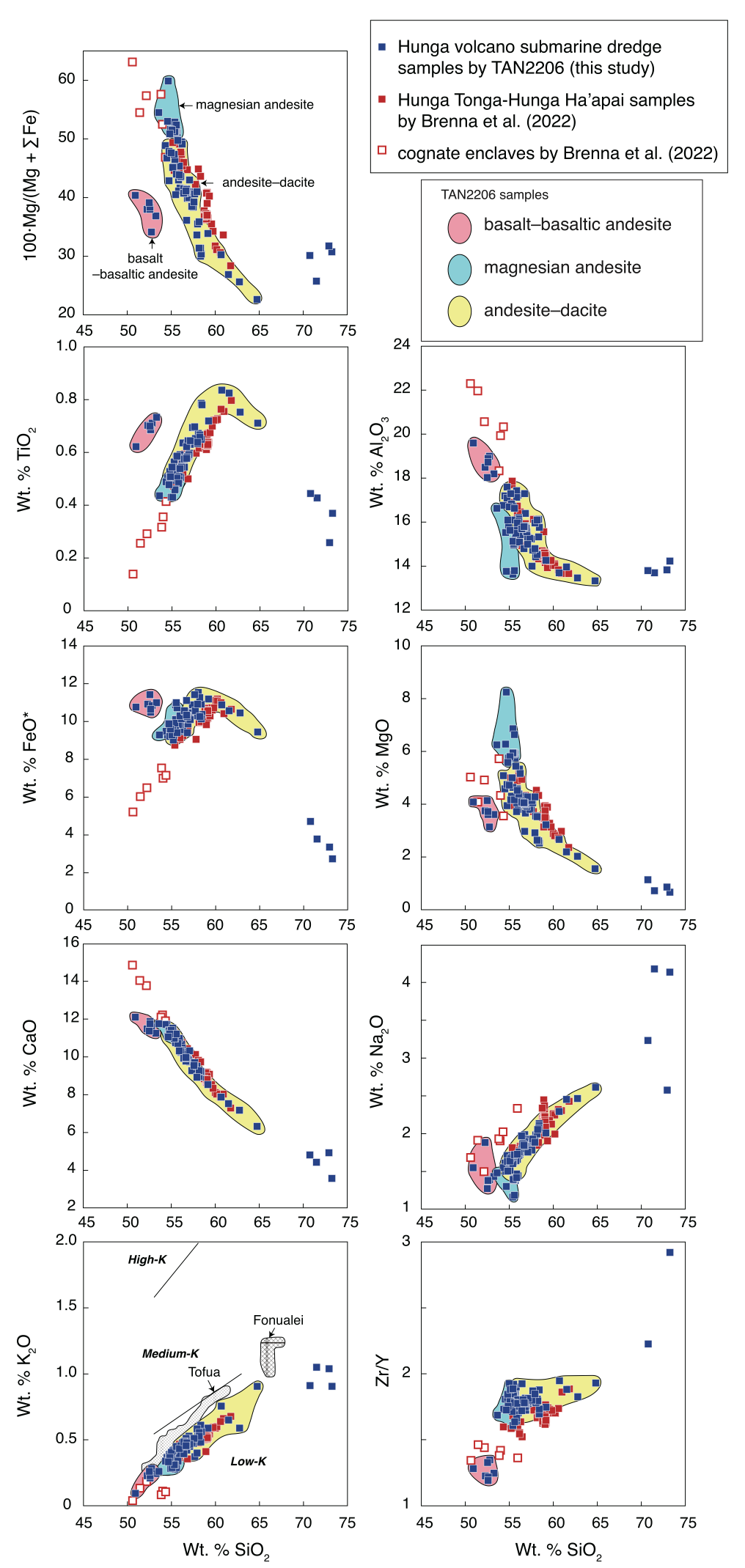
[Figure 5] Volcanic rock samples collected from the submarine flanks of Hunga Volcano. While previous subaerial studies only recorded andesite, this seafloor survey confirmed the presence of basalt and magnesian andesite for the first time.
■ Unmasking Two Disjointed Magma Birthplaces via Quantitative Modeling
To reconstruct the pristine "primary magma" composition before it ascended, crystallized, and fractionated, the team utilized an olivine-addition quantitative reverse model. Cross-referencing these compositions with high-temperature, high-pressure mantle phase equilibrium experimental data proved that the plumbing system was fueled by two independent primary magmas born at vastly different mantle depths:
Primary Basaltic Magma
Generated deep within the mantle (approx. 40–50 km depth / ~1.5 GPa pressure).
Primary Magnesian Andesitic Magma
Generated within the ultra-shallow mantle (approx. 15–20 km depth / ~0.5 GPa pressure).
■ Global Universality of Japan's "Nishinoshima Model" Confirmed
The discovery of a primary magnesian andesite magma originating from the uppermost mantle (15–20 km depth) is highly significant. This low-pressure mantle melt is a signature product of thin oceanic island arcs and acts as the literal cornerstone of JAMSTEC's continental genesis theory (the Nishinoshima Model). Finding an identical signature at the Tonga arc scientifically validates that the shallow-mantle generation of andesitic magma is not a regional anomaly, but a universal planetary blueprint across the Western Pacific.
■ Magma Intermixing Parallel to Nishinoshima Eruptive Dynamics
The study also yields crucial insights into marine eruption dynamics. JAMSTEC's previous work demonstrated that recent explosive eruptions at Nishinoshima were driven by deep-seated basaltic magma injecting into and violently mixing with a pre-existing shallow andesitic reservoir (Tamura et al., 2023).
A highly parallel mechanism is now inferred for Hunga Volcano. The two independent primary magmas ascended into a shallow chamber a few kilometers beneath the seafloor, undergoing complex interaction. Specifically, the violent, rapid injection of volatile-rich, high-temperature deep basaltic magma into the cooler andesitic reservoir likely supplied the ultimate energetic trigger responsible for the extreme explosive yield of the 2022 disaster.
This milestone represents a flawless convergence of JAMSTEC’s state-of-the-art geo-analytical capabilities, deep oceanic arc petrological expertise, and New Zealand's world-class maritime research infrastructure.
4. Future Outlook
This discovery marks a profound paradigm shift, verifying that a "polybaric multi-system magma plumbing model"—where multiple independent primary magmas are supplied concurrently from varying mantle depths—underpins large-scale explosive submarine volcanism. Beyond illuminating a critical chapter of the Hunga eruption plumbing system, it provides a vital reinforcing piece to the primordial question of Earth's history: "How were the continents born?"
Moving forward, the research team intends to conduct comparative analyses across diverse Western Pacific submarine systems to deepen our understanding of planetary evolution. Concurrently, to address pressing societal risks, the group will investigate the critical eruption "time-scale"—quantifying the exact time window available between the initial magma mixing event and the final explosive eruption—by analyzing crystal growth histories.
Through these dual scientific tracks, this research will contribute to building a robust, predictive scientific foundation for submarine volcanic hazard assessments and disaster mitigation strategies, safeguarding both Japan and coastal communities globally.
Primary Literature
- Tamura et al. (2016) Sci Rep 6:33517. https://doi.org/10.1038/srep33517
- Tamura et al. (2019) Island Arc 28:e12285. https://doi.org/10.1111/iar.12285
- Tamura et al. (2023) Front Earth Sci 11:1137416. https://doi.org/10.3389/feart.2023.1137416
Media Contacts
Japan Agency for Marine-Earth Science and Technology (JAMSTEC)
Regarding the Scientific Research: Dr. Yoshihiko Tamura, Senior Research Scientist Volcanoes and Earth's Interior Research Group, Research Institute for Marine GeodynamicsRegarding Media Relations & Press Inquiries: Public Relations Division, Marine Science and Technology Strategy Department
Earth Sciences New Zealand
Regarding Media Relations & Press Inquiries: Oceans, Aquaculture and FisheriesNational Institute of Advanced Industrial Science and Technology (AIST)
Regarding Media Relations & Press Inquiries: Branding and Public Relations Department Press Office