Outline
Our research group aims to elucidate the mechanisms of great earthquakes from a materials-science perspective. We analyze fault-core samples and drilling data obtained through seafloor drilling conducted by the deep-sea drilling vessel Chikyu, and we investigate the physical and chemical properties of faults through rock-deformation experiments and numerical simulations. In addition, we survey and document traces of historical earthquake-related disasters preserved on the seafloor and on land, building archives to better constrain the real-world behavior of great earthquakes. To advance these studies, we also develop new research methods and experimental apparatus.
Detail of Rock Mechanics Research
We integrate the latest findings from our members’ diverse areas of expertise to pursue a common goal: elucidating earthquake source environments and earthquake-generation processes. Our representative research themes are as follows.
- Low- to high-velocity frictional and mechanical properties of fault materials
- Quantification and generation mechanisms of gases produced during fault slip
- Fluid-transport properties of sediments and coseismic pore-pressure variations
- Deciphering dynamic slip behavior recorded in natural faults preserved in core samples
- Constraining in-situ conditions of seismogenic zones through petrophysical measurements and downhole logging analyses
- Measurements of thermal properties, electrical resistivity, and elastic-wave velocities of sediments under in-situ stress conditions
- Analogue and in-situ-condition experiments on transitions between fluidization/flow and brittle failure in earthquake and volcanic processes
- Separating and quantifying the physical processes controlling interseismic fault-strength recovery (healing)
- Provenance and history of stone heritage structures inferred from non-destructive rock-property analyses
- Preservation of historical natural-disaster records and their application to disaster education
- Investigations of disaster traces preserved at underwater archaeological sites
- Exploration and research on subseafloor natural resources
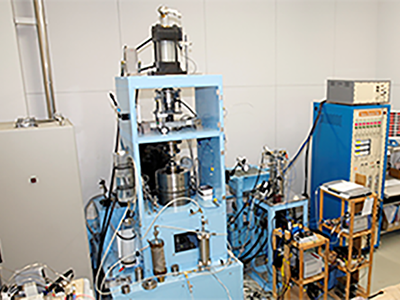 The world’s first fluid-pressure-controlled apparatus for low-to-high-velocity friction experiments (installed February 2008)
It enables friction experiments that simulate fault slip under elevated pore-fluid pressures representative of deep subsurface conditions. |
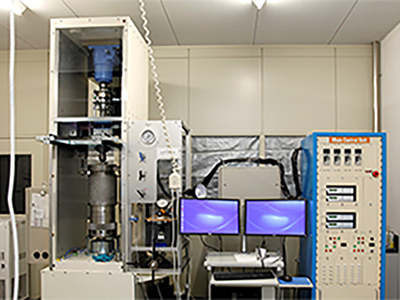 Newly developed rotary hydrothermal apparatus for low-to-high-velocity friction experiments (installed February 2017)
It was designed to simulate slow-slip and seismic fault slip under hydrothermal conditions in seismogenic zones. |
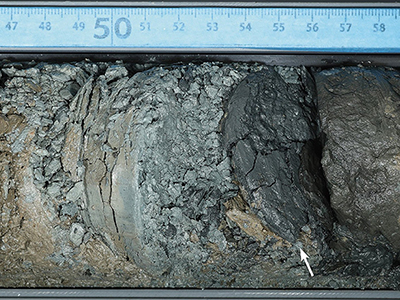 Example of a fault zone recovered by ocean drilling (white arrow)
By sampling and analyzing faults and surrounding sediments from drilling and field investigations, we study fault slip behavior and the environmental conditions at earthquake source regions. |
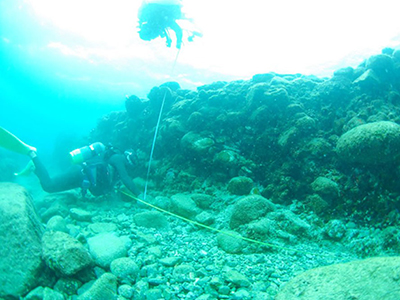 Field Survey of Underwater Structures
We survey and measure structures that record crustal deformation and archaeological sites that preserve disaster traditions. We quantify these records to estimate the magnitudes of past disasters, and we also work on preserving these remains and applying them to disaster education. |
萩谷名号碑(高知県土佐市) by Tanikawa Wataru on Sketchfab
Initiative to create 3D archives of stone monuments in Kochi Prefecture that preserve records of historical Nankai earthquakes. (The photo shows the Ansei Nankai Earthquake monument in Tosa City)
Drawing on these records of earthquake disasters, we also reconstruct past earthquake processes.
 This research was supported by JSPS KAKENHI Grant Number JP15K12487.