Ceramics pressure-resistant spherical housing, 445 mm in diameter
High-strength structural material for structural members of deep-water vehicles and containers for underwater equipment have been developed.
Ceramics pressure-resistant spherical housing that can withstand the pressure of water depth up to 11,000 m has been developed for self-pup-up ocean-bottom seismometers.
A prototype hybrid (allied carbon and metals) pressure-resistance container has also been created.
High-speed Communication System
High-speed communication system has been developed to enable monitoring and control of floating observation equipment, such as a buoy and an AUV surfacing, from a land base.
In 2010, test was done on the real-time deep-sea HDTV image transmission from the MR-X1 to JAXA’ Tsukuba Space Center via Kizuna, the Wide-band Internetworking Engineering Test and Demonstration Satellite.
Power System for Long-term Observation
A liquid fuel-cell for long-term observation in the deep sea has been developed.
In 2010, a performance test of the fuel cell was carried out, and a prototype of the Lithium Ion battery equipped with an automatic cell voltage balance-controller has been built.
Southern Ocean Buoy
The Southern Ocean Buoy is an observation platform, the first in the Southern Ocean area, that has been developed to contribute to the study of ocean circulation and climate change.
In 2010, a behavior analysis test was conducted to analyze basic behavior on the coast of Hokkaido in winter using the present buoy.
Projected Environmental Conditions of the Southern Ocean Buoy
Maximum wind speed: 20 m/s
Surface current: 50 cm/s
Wave height: 8 m
Minimum temperature: -10
Sea ice concentration: under 1/10 (winter)
Shuttle vehicle for Virtual Mooring
Long-term ocean monitoring by shuttle vehicles
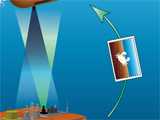
A new project to develop a shuttle vehicle for virtual mooring has been initiated. The vehicle will stay at the designated site and will perform long-term monitoring of the marine environment from the sea-bottom to the surface; it will return the data via satellites.
In 2010, measurements of hydrodynamic characteristics are being made using a small-sized model, and a prototype vehicle is being developed.