
D-ARK
- Home
- Topics
- About_us
- Members
- Reports
- Galleries
(coming soon) - Publications
- Technology Development
(coming soon) - New and Rare Species

Publications
FY2026
Peer-reviewed publications
First Japanese record of Parupeneus moffitti (Teleostei: Mullidae) from Kitadaito Island
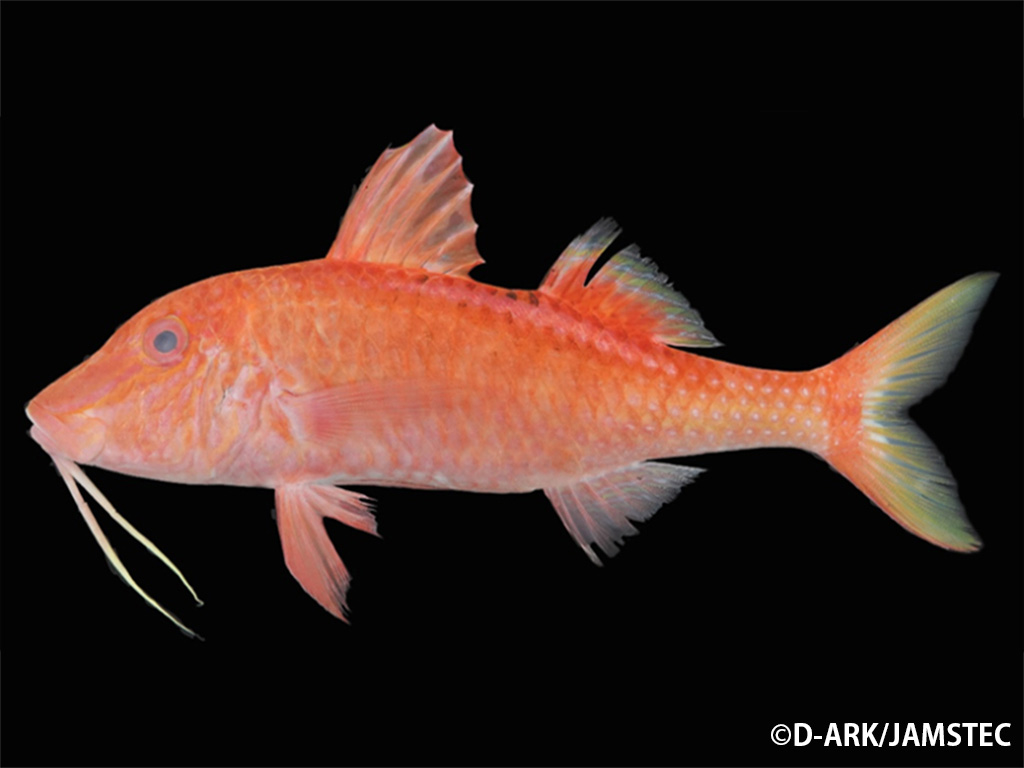
A single specimen of Parupeneus moffitti Randall and Myers, 1993, previously known only from three type specimens collected in the Mariana Islands, was collected off Kitadaito Island, southern Japan, in August 2025. The present specimen therefore represents the second record of the species and the first from Japanese waters. The new standard Japanese name “Kotou-himeji” is proposed for the species.
Shinoda S, Kaneko T, Koeda K (2026) First Japanese record of Parupeneus moffitti (Teleostei: Mullidae) from Kitadaito Island. Species Diversity 31: 263–269.
DOI: 10.12782/specdiv.31.263
RYUKYU University Press release
A New Species of Cyphosaccus (Crustacea, Cirripedia, Rhizocephala, Peltogasterellidae) from Kitadaito Island, Japan
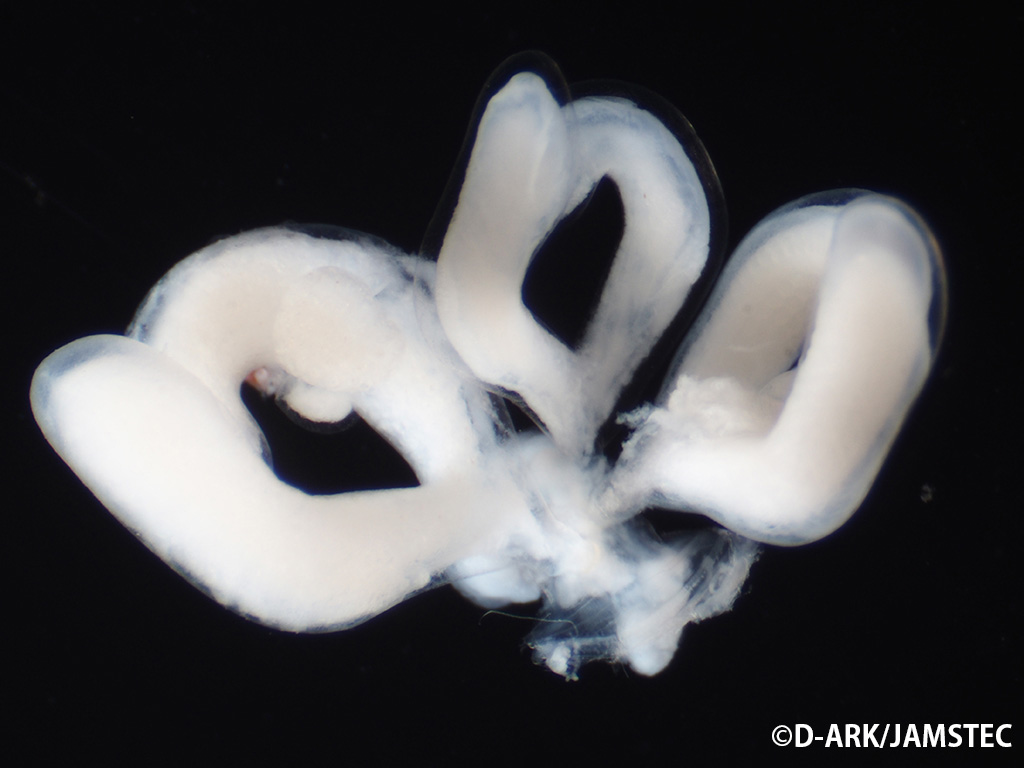
A new rhizocephalan barnacle species, Cyphosaccus daitoensis sp. nov., is described from Kitadaito Island, Japan, based on specimens recovered from the squat lobster Babamunida sp. This represents the first record of the genus Cyphosaccus in the Western Pacific and expands the known host range of the genus to include Babamunida. This discovery contributes to the understanding of rhizocephalan diversity in the Western Pacific.
Jimi N, Yokooka H, Koeda K, FujiwaraY (2026) A New Species of Cyphosaccus (Crustacea, Cirripedia, Rhizocephala, Peltogasterellidae) from Kitadaito Island, Japan. Pacific Science 80(1):47–54.
doi:10.2984/80.1.6
First Northwestern Pacific Record of the Batfish Solocisquama erythrina (Actinopterygii: Ogcocephalidae) from Minamidaito Island, Southern Japan
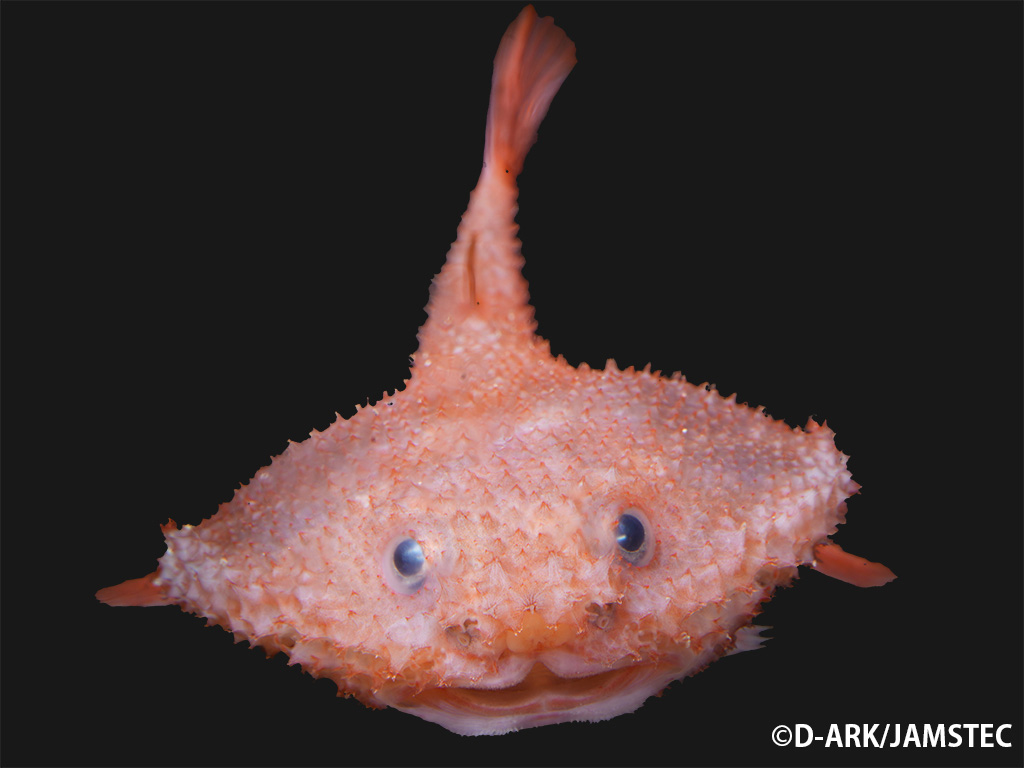
A single specimen of the rare batfish Solocisquama erythrina (Gilbert, 1905) was collected from a steep rocky seafloor off Minamidaito Island, southern Japan. The species had been considered as a Hawaiian endemic. However, the specimen from the Daito Islands represents the first record of S. erythrina from the northwestern Pacific region, including Japanese waters, and is further evidence of a commonality of the deep-sea fish fauna between oceanic islands in the central and western Pacific regions.
Sato M, Abe K, Tsuchida S, Kawato M, Fujiwara Y, Koeda K(2026) First Northwestern Pacific Record of the Batfish Solocisquama erythrina (Actinopterygii: Ogcocephalidae) from Minamidaito Island, Southern Japan. Species Diversity 31: 213–219.
doi:10.12782/specdiv.31.213
RYUKYU University Press release
First Japanese Record of the Deep-sea Scorpionfish Phenacoscorpius megalops (Teleostei: Scorpaenidae) from Minamidaito Island
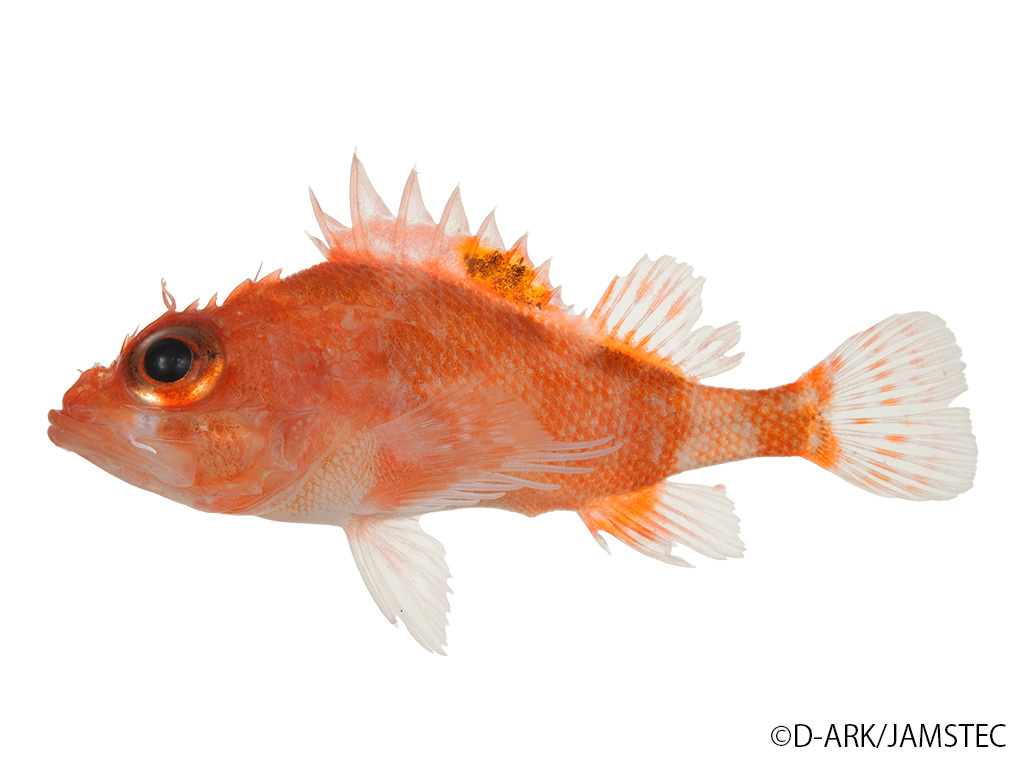
A single specimen of the deep-sea scorpionfish Phenacoscorpius megalops was collected by ROV from within a colonial sun coral inhabiting a steep seafloor off Minamidaito Island, southern Japan. Although this species has previously been reported from the western and central Pacific, including waters off the Hawaiian Islands, this represents the first record from Japanese waters.
Sato M, Koeda K, Fujiwara Y (2026) First Japanese record of the deep-sea scorpionfish Phenacoscorpius megalops (Teleostei: Scorpaenidae) from Minamidaito Island. Species Divers 31: 63-69.
doi:10.12782/specdiv.31.63
Other publications
Fujiwara Y (2026) D-ARK: The World’s First Deep-Sea Cave Exploration Project: Developing Technologies to Explore Uncharted Deep-Sea Caves. Techno-Ocean News 94: 3–4.
FY2025
Peer-reviewed publications
New record of the hydromedusa Tetrorchis erythrogaster (Hydrozoa: Trachymedusae) from Japan
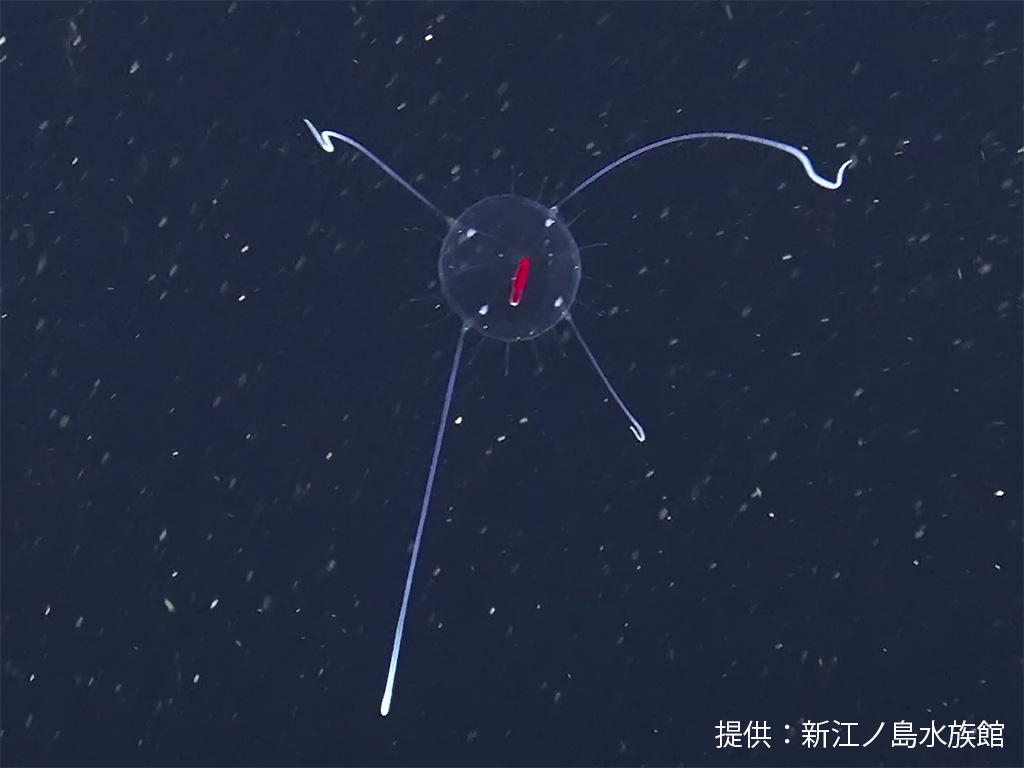
A deep-sea hydrozoan jellyfish, Tetrorchis erythrogaster, was collected off Atami, Shizuoka Prefecture, at a depth of approximately 650 m. The Japanese name “Homura-tsunogasa-kurage” is proposed for this species because the shape of its bell resembles a traditional Japanese hat called a “tsunogasa”, while its vivid red manubrium evokes the image of a flame flickering in the dark deep sea, expressed in Japanese as “homura.” This species has rarely been observed worldwide, and this study represents the first record from Japan.
Yamamoto G, Toshino S, Ito S, Watabe M (2026) New record of the hydromedusa Tetrorchis erythrogaster (Hydrozoa: Trachymedusae) from Japan. Biogeography 29: 8–13.
doi:10.11358/biogeo.29.8
Azooxanthellate colonial corals from the Miocene Omori Formation, Shimane, Japan
We describe three azooxanthellate corals from the Miocene Omori Formation in Shimane, Japan, and report a new species, Dendrophyllia mokiensis sp. nov. This discovery sheds light on changes in azooxanthellate coral communities in deep-water coral habitats during the Cenozoic.
Tokuda Y, Yamada N, Endo H, Sentoku A, Ezaki Y, Hayashi H, Matsuura Y, Kawano S (2025) Azooxanthellate colonial corals from the Miocene Omori Formation, Shimane, Japan. Paleontol Res 28: 108–121.
doi:10.2517/2024PR010
Vanderhorstia supersaiyan sp. nov. (Perciformes: Gobiidae) collected from the twilight zone off Ishigaki-jima Island, Okinawa, Japan
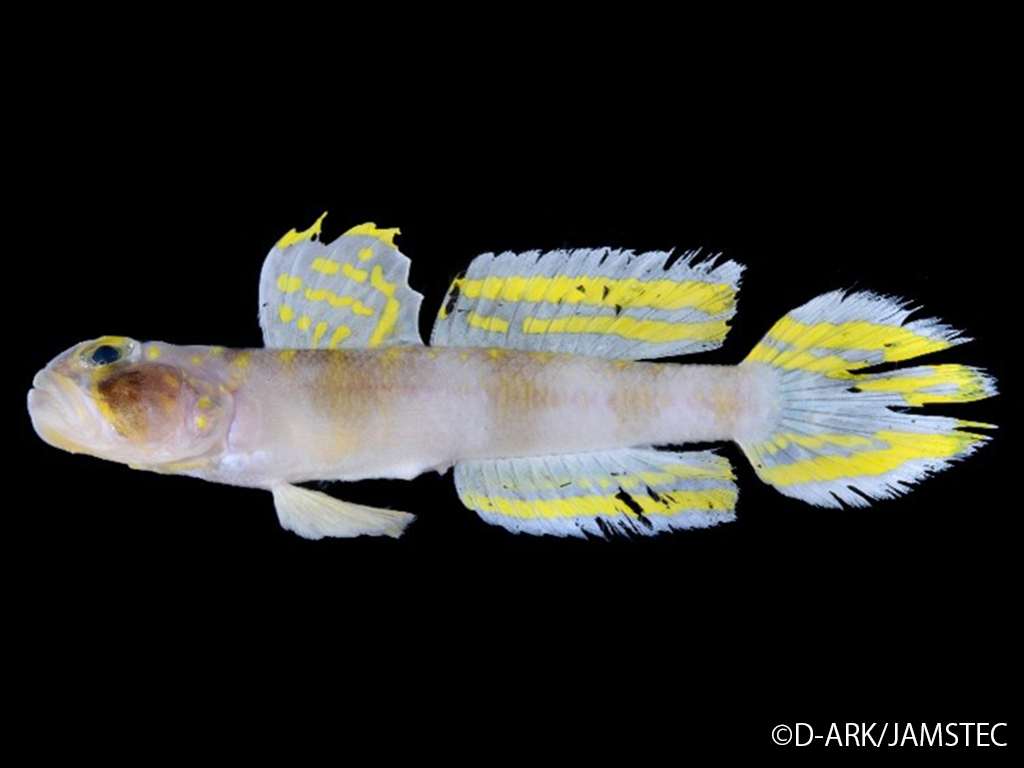
A new species of goby fish Vanderhorstia supersaiyan sp. nov. (Perciformes: Gobiidae) was discovered in deep water near Okinawa, Japan. It was found at 210 meters depth and is easily recognized by its bright yellow stripes and markings. Unlike its close relatives, which live in shallow water, this fish lives in the ocean’s “twilight zone,” showing that this little-studied deep habitat still holds many undiscovered species.
Keita Koeda, Hiroshi Hirasaka, Mao Sato (2025) Vanderhorstia supersaiyan sp. nov. (Perciformes: Gobiidae) collected from the twilight zone off Ishigaki-jima Island, Okinawa, Japan, Ichthyological Research, 27 November 2025, 10.1007/s10228-025-01047-6
- University of the Ryukyus Press Release
https://www.u-ryukyu.ac.jp/news/72516/
Records of some deep-sea corals (Antipatharia and Octocorallia) from the Daito Islands, Okinawa, Japan
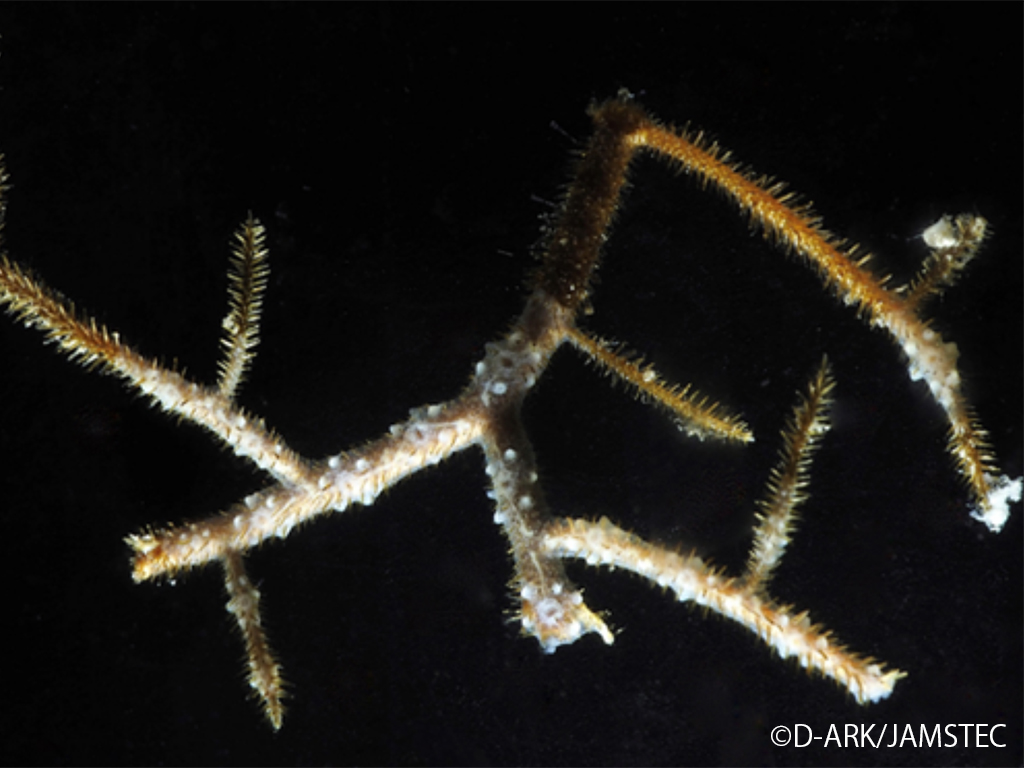
This study reports the first observations of deep-sea corals around Daito Islands in Okinawa, Japan. The corals were found at depths of 200–1,000 meters, including a black coral species recorded in this region for the first time. These findings highlight the importance of further research and protection of deep-sea habitats in this area.
Kurt Bryant B. Bacharo, Kylie Villareal, Hiroki Kise, Asuka Sentoku, Hiroyuki Yokooka, Shinji Tsuchida, Yoshihiro Fujiwara, James Davis Reimer, Records of some deep-sea corals (Antipatharia and Octocorallia) from the Daito Islands, Okinawa, Japan, Marine Biological Association of the United Kingdom, Volume 105, 2025, e127, 10.1017/S0025315425100817
A bioluminescent deep-sea polychaete within the genus Aricidea (Paraonidae) from Minamidaito Island, Japan
This study reports the discovery of a deep-sea polychaete that emits green light when stimulated. The worm was found near Minamidaito Island in the Pacific Ocean and belongs to the genus Aricidea. Genetic analysis suggests it may be an undescribed species, marking the first report of bioluminescence in its family.
Manabu Bessho-Uehara, Naoto Jimi, Yoshihiro Fujiwara (2025) A bioluminescent deep-sea polychaete within the genus Aricidea (Paraonidae) from Minamidaito Island, Japan, Scientific Reports volume 15, Article number: 36573 (2025) , 10.1038/s41598-025-20544-2
Genomic sequences of free-living Pseudoalteromonas species isolated from seawater using an ethylene-α-olefin co-oligomer as a sole carbon source
This study reports two marine bacteria isolated from seawater using a plastic-like compound as their only food source. Their genomes were analyzed, providing clues about how bacteria interact with polyolefin materials, even though they lack known genes for breaking them down.
Ryo Iizuka, Takao Yoshida, Masaru Kawato, Yoshihiro Fujiwara, Sotaro Uemura (2025)Genomic sequences of free-living Pseudoalteromonas species isolated from seawater using an ethylene-α-olefin co-oligomer as a sole carbon source, Microbiol Resour Announc., 10.1128/mra.00785-25
Glow in the D-ARK: a new bioluminescent species of Corallizoanthus (Anthozoa: Zoantharia: Parazoanthidae) from southern Japan
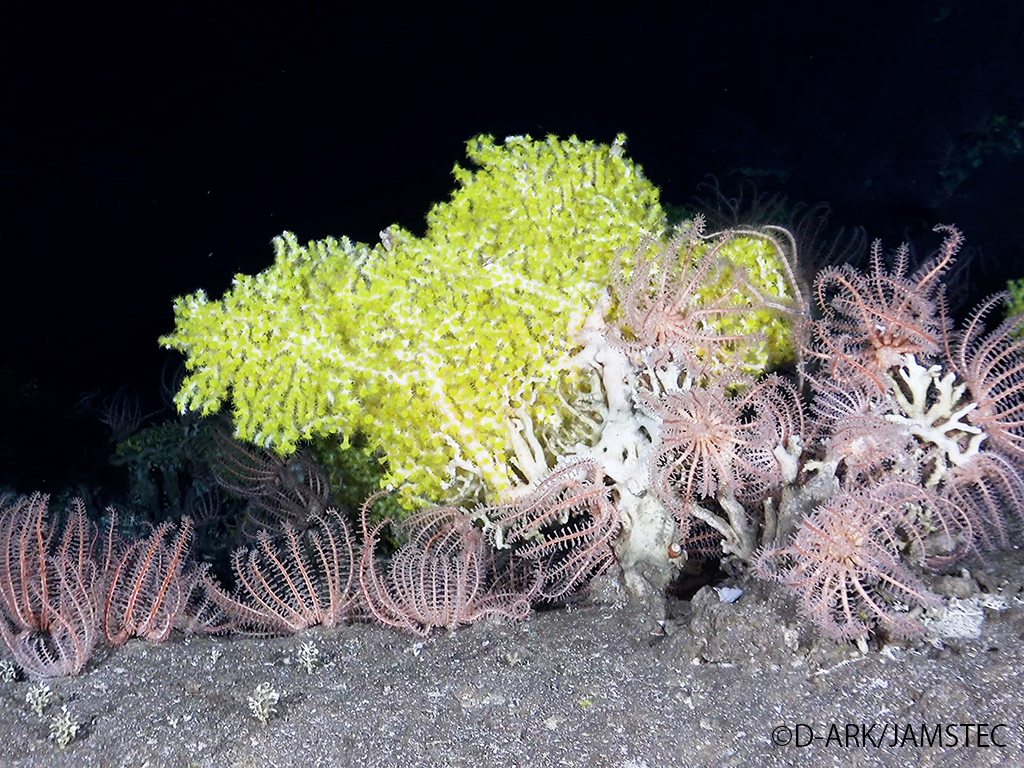
A new species of zoantharian, Corallizoanthus aureus, was discovered in and around a deep-sea cave in the Daito Islands, Japan. During the research expedition, we successfully obtained ROV footage showing this species emitting light in response to stimulation. This represents the first documented observation of bioluminescence within a deep-sea cave anywhere in the world. The specific name derives from ‘aureus’ meaning ‘golden’ in Latin.
Hiroki Kise, Manabu Bessho-Uehara, Kenta C. F. Kondo, Kiko Shimoji, Shohei Ito, Shinji Tsuchida, Yoshihiro Fujiwara, and James D. Reimer(2025) Glow in the D-ARK: a new bioluminescent species of Corallizoanthus (Anthozoa: Zoantharia: Parazoanthidae) from southern Japan, Royal Society Open Science, Published:05 November 2025, DOI: https://doi.org/10.1098/rsos.250890
- RYUKYU University Press release
https://www.u-ryukyu.ac.jp/news/72071/ - JAMSTEC Press release
https://www.jamstec.go.jp/j/about/press_release/20251106/
New deep-sea terebellid polychaete with sucker like ventral pads adapted to a sediment free environment
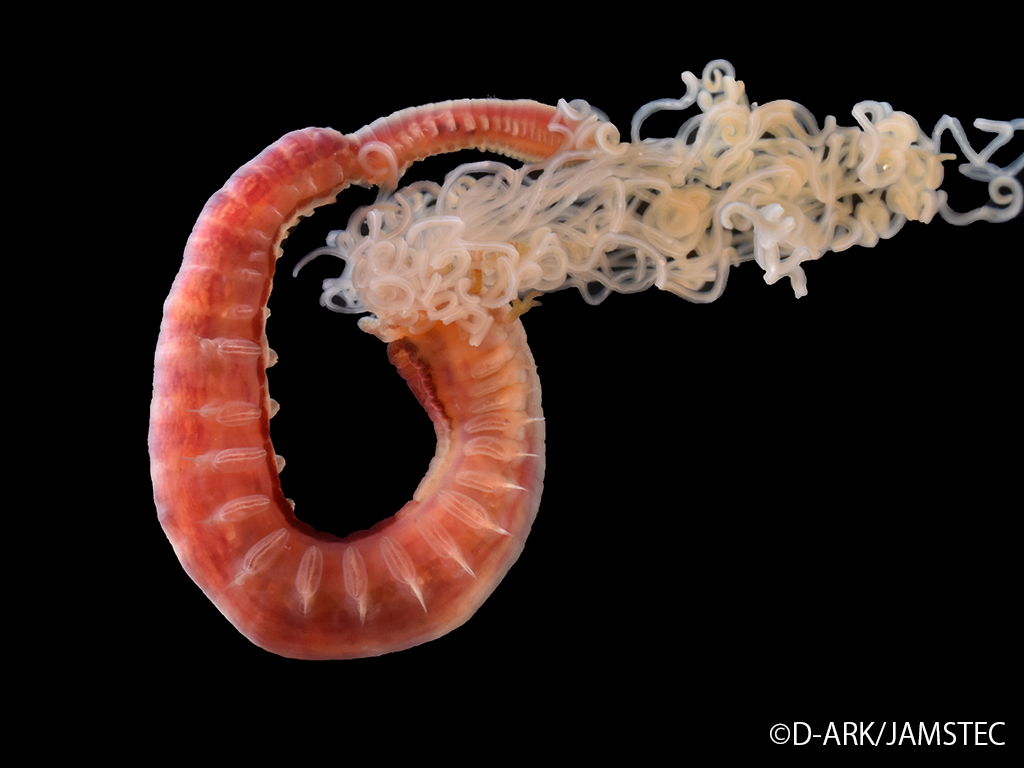
A new species of terebellid polychaete, Lanice spongicola, is described from deep-sea sponges in the northwestern Pacific Ocean off Minamidaito Island, Okinawa, Japan. This species is associated with the sponge Walteria cf. leuckarti at a depth of 843 m.
The anterior area of ventral pad is used as an adhesion organ, facilitating attachment to the host sponge. This terebellid species differs from the typical sediment-dwelling lifestyle, having adapted to a sediment-free environment through its association with sponges and the development of specialized sucker structures for attachment.
Naoto Jimi, Geminne G. Manzano, Natsumi Hookabe, Hiroki Kise, James Davis Reimer, Sau Pinn Woo, Yoshihiro Fujiwara(2025)New deep sea terebellid polychaete with sucker like ventral pads adapted to a sediment free environment, Sci Rep 15, 36307 (2025), DOI:https://doi.org/10.1038/s41598-025-23333-z
- NAGOYA University Press release
https://www.nagoya-u.ac.jp/researchinfo/result/upload_images/20251104_sci.pdf - JAMSTEC Press release
https://www.jamstec.go.jp/j/about/press_release/20251104/
Ribbon worms living on deep-sea trees: Alvinonemertes daitoensis sp. nov. (Nemertea, Monostilifera) associated with the glass sponge Walteria leuckarti (Porifera, Hexactinellida)
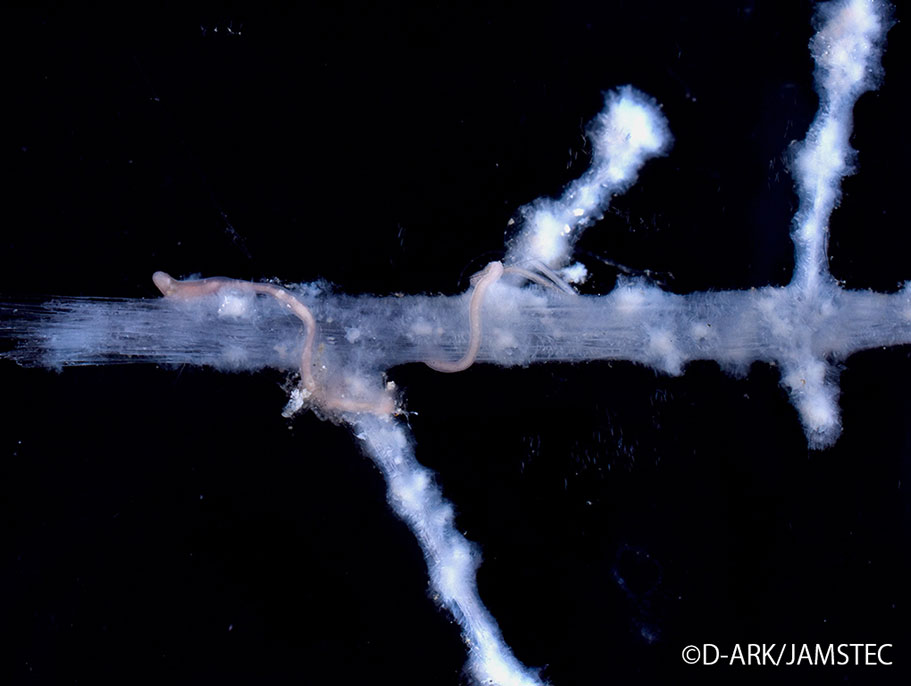
We discovered a new species of nemertean, Alvinonemertes daitoensis sp. nov., at a depth of 843 meters northwest of Minamidaito Island, Japan. This species is closely associated with the hexactinellid glass sponge Walteria leuckarti. It shows a distinctive ecological behavior, wrapping around the branches of its host sponge, similar to Alvinonemertes dariae and Sagornya dagmarae, suggesting convergent arboreal adaptations to tree- shaped host animals. The Japanese name of the species is “Daito Kinobori Himomushi,” based on this unique lifestyle.
Natsumi Hookabe, Geminne G. Manzano, Naoto Jimi, Hiroki Kise, James Davis Reimer, Shinji Tsuchida & Yoshihiro Fujiwara (2025) Ribbon worms living on deep-sea trees: Alvinonemertes daitoensis sp. nov. (Nemertea, Monostilifera) associated with the glass sponge Walteria leuckarti (Porifera, Hexactinellida), Systematics and Biodiversity, 23:1, 2504484, DOI:10.1080/14772000.2025.2504484
Other publications
Fujiwara Y (2026) Does a “living fossil” exist in deep-sea caves? —The world’s first deep-sea cave exploration project “D-ARK”. Taxa 60: 24-30. doi:10.19004/taxa.60.0_24
Ito S (2026) Unexplored areas explored by mini-ROV. Taxa 60: 20-23. doi:10.19004/taxa.60.0_20
Jimi N, Hookabe N, Fujimoto S (2026) Hidden frontiers of the deep sea: new research illuminates unexplored ecosystems. Taxa 60: 3-5. doi:10.19004/taxa.60.0_3
Narushima H (2025) The future of the ocean begins with “knowing”: connecting children to biodiversity through deep-sea caves. Ocean Newslett 598: 2–3
Sasaki D, Abe K, Koeda K, Kimura S (2025) Records of the Hawaiian flagtail Kuhlia sandvicensis (Centrarchiformes: Kuhliidae) from the oceanic islands of Japan. Jpn J Ichthyol 72: 243–249
Academic presentations
Abe K, Koeda K (2026) Shallow-sea fish fauna in the Daito Islands. 9th Okinawa Fish Seminar. Nishihara. Oral
Bergman LA, Tsuchida S, Fujiwara Y, Ito S, Kise H, Sato M, Koeda K (2026) Deep-sea caves at the Daito Islands, Okinawa, host distinct benthic megafauna communities. The Ocean and Earth Symposium 2025. Tokyo. Oral
Fujiwara Y, Tsuchida S, Kawato M, Yoshida T, Hookabe N, Bergman LA, Itoh Y, Narushima H, Fukawa N, Koeda K, Sentoku A, Sato M, Bacharo KBB, Ishibashi D, Abe K, Reimer JD, Jimi N, Sako M, Shimooka T, Nanjo K, Isaka H, Kita Y, Kushida Y, Kise H, Yamaki A, Matsuki K, Yokooka H, Ohno A, Masuda K, Ito S, Daikoku Y, Mitsufuji K, Koyama Y, Yasuda T, Sugimoto Y, Serizawa K (2026) Overview of the deep-sea cave exploration project D-ARK cruise (KM25-06C). The Ocean and Earth Symposium 2025. Tokyo. Oral
Fujiwara Y, D-ARK Team (2025) Exploring Deep-Sea Caves— Activities of the Ocean Shot Program “D-ARK” —. 129th Marine Technology Liaison Committee Meeting. Tokyo. Oral.
Sato M, Takahata A (2026) Morphological and ecological diversity of paedomorphic species in Apogonidae. 9th Okinawa Fish Seminar. Nishihara. Oral
Shinoda S, Koeda K (2026) Taxonomic study of Parupeneus insularis. 9th Okinawa Fish Seminar. Nishihara. Oral
Takahata A, Koeda K (2026) Diversity of spatiotemporal utilization strategies of marine caves in fishes. Fish Ecology Workshop. Shimonoseki. Oral
Yamaki A, Narushima H, Fujiwara Y (2026) Deep-sea cave exploration project “D-ARK”: focusing on outreach activities. The Ocean and Earth Symposium 2025. Tokyo. Poster
Abe K, Sato M, Ito S, Fujiwara Y, Koeda K (2025) Fishes observed in the twilight zone around Minamidaito Island using ROV surveys. Annual Meeting of the Ichthyological Society of Japan. Tokyo. Oral
Bacharo KBB, Villareal K, Kise H, Sentoku A, Yokooka H, Horowitz J, Hookabe N, Tsuchida S, Fujiwara Y, Reimer JD (2025) Illuminating the diversity of deep-sea anthozoans found in selected sites of the northwestern Pacific. 17th Deep-Sea Biology Symposium. Hong Kong. Oral
Bergman LA, Koeda K, Reimer JD, Sentoku A, Chris M, Yokooka H, Sato M, Bacharo KBB, Tsuchida S, Fujiwara Y (2025) Diversity across the Philippine Sea: benthic megafauna community composition across four ridges in southern Japan. 17th Deep-Sea Biology Symposium. Hong Kong. Oral
Bergman LA et al. (2025) Examining benthic megafauna community composition across four ridges in the Philippine Sea. JAMSTEC International Day. Yokosuka. Oral
Fukushima S, Koeda K (2025) A new subspecies of Ostorhinchus semilineatus discovered from the twilight zone off Okinawa-jima Island. Joint Conference of the Asian Society of Ichthyologists and the 12th Indo-Pacific Fish Conference. Taipei. Oral
Fukushima S, Koeda K (2025) Taxonomic review of the Ostorhinchus endekataenia species group. Annual Meeting of the Ichthyological Society of Japan. Tokyo. Oral
Ishihara H, Sentoku A, Tokuda Y, Shiromizu N, Ito S, Oono A, Tsuchida S, Fujiwara Y (2025) Distribution and diversity of scleractinian corals in the Kyushu–Palau Ridge. Zoological Society of Japan. Nagoya. Poster
Ito S (2025) Deep-sea cave exploration project D-ARK. Underwater Technology Forum ZERO. Kashiwa. Oral
Ito S (2025) Exploring unexplored environments using a mini-ROV: the deep-sea cave explorer “DroSea”. Symposium of the Japanese Society of Systematic Zoology. Nagoya. Oral
Ito S (2025) The world revealed by underwater drones. Umi-Hama Vol.5 Science Talk. Osaka. Oral
Jimi N (2025) An undescribed terebellid polychaete associated with branching sponges possessing sucker-like structures. Zoological Society of Japan. Nagoya. Poster
Jimi N, Hookabe N, Fujimoto S (2025) Frontier of the deep sea: unexplored ecosystems revealed by recent research. Symposium of the Japanese Society of Systematic Zoology. Nagoya. Oral
Kise H, Bessho-Uehara M, Kondo K, Shimoji K, Tsuchida S, Fujiwara Y, Reimer JD (2025) An undescribed zoantharian species symbiotic with dead corals and its bioluminescence. Japanese Society of Systematic Zoology. Tsukuba. Oral
Koeda K, Sato M, Ito S, Takashima S, Oono A, Kawato M, Yoshida T, Bergman LA, Tsuchida S, Fujiwara Y (2025) Fish diversity of seamounts through direct approaches. Joint Conference of the Asian Society of Ichthyologists and the 12th Indo-Pacific Fish Conference. Taipei. Oral
Miyahara A, Tokuda Y, Kuroki T, Matsunaga K, Sentoku A (2025) Phylogenetic study of the scleractinian coral genus Paracyathus. Japanese Coral Reef Society Meeting. Nago. Oral
Ohshiro Y, Sentoku A, Shiromizu N, Ishihara H, Tokuda Y, Ito S, Oono A, Tsuchida S, Fujiwara Y (2025) Asexual reproduction mode of Truncatoflabellum phoenix. Zoological Society of Japan. Nagoya. Poster
Sasaki D, Abe K, Koeda K, Kimura S (2025) Records of the Hawaiian flagtail Kuhlia sandvicensis from the oceanic islands of Japan. Japanese Journal of Ichthyology Meeting. Tokyo. Oral
Sentoku A, Nishihata J, Shiromizu N, Yoshihara M, Kamiza S, Tokuda Y (2025) Comparative skeletal analysis of zooxanthellate and azooxanthellate solitary corals. Palaeontological Society of Japan Meeting. Sapporo. Oral
Shiromizu N, Sentoku A, Tokuda Y, Ishihara H, Ito S, Oono A, Tsuchida S, Fujiwara Y (2025) Deep-sea scleractinian coral fauna around the Daito Islands. Zoological Society of Japan. Nagoya. Poster
Takamura Y, Tokuda Y, Sentoku A (2025) Colony formation patterns in the coral genus Madracis. Japanese Coral Reef Society Meeting. Nago. Oral
Award
Abe K, Sato M, Ito S, Fujiwara Y, Koeda K (2025) Best Oral Presentation Award. The Ichthyological Society of Japan, Annual Meeting 2025, Tokyo University of Marine Science and Technology, Tokyo, Japan.
“Fishes observed in the twilight zone around Minamidaito Island using ROV surveys”
Hookabe N, Manzano GG, Jimi N, Kise H, Reimer JD, Tsuchida S, Fujiwara Y (2025) Taylor & Francis Outstanding Paper Award (Syst Biodivers). Taylor & Francis. “Ribbon worms living on deep-sea trees: Alvinonemertes daitoensis sp. nov. (Nemertea, Monostilifera) associated with the glass sponge Walteria leukarti (Porifera, Hexactinellida)”
Kise H, Bessho-Uehara M, Kondo KC, Shimoji K, Ito S, Tsuchida S, Fujiwara Y, Reimer JD (2025) Selected as one of the WoRMS Top Ten Marine Species 2025. World Register of Marine Species (WoRMS).
“Corallizoanthus aureus”
Sentoku A (2025) Academic Award of the Palaeontological Society of Japan. The Palaeontological Society of Japan.
“Evolutionary paleobiological study on coral growth forms, functional morphology, and environmental adaptation”
Public outreach lectures and presentations
Fujiwara Y (2026) Welcome to the deep-sea world! Special Lecture in Hachijo Island, Hachijo Town. Oral
Fujiwara Y (2026) Frontiers in deep-sea biology: Yokozuna, whale falls, and deep-sea caves. The 9th Heda Deep-Sea Fish University, Numazu. Oral
Fujiwara Y (2026) Whale falls, Yokozuna, and deep-sea caves: frontiers in deep-sea biology. Joint Environmental Lecture by Nerima City Libraries, Tokyo. Oral
Abe K (2025) Fishes of the Daito Islands. Daito Society Meeting, Minamidaito Village. Oral
Araki Y, Tsubaki R, Takagi Y, Sato S, Sentoku A, Yoshida K, Inaba A, Hosogai K, Matsumoto K, Ide K, Matsuura K, Ishida S, Nagai Y, Toyofuku T (2025) Experiential visual communication: practical comment mapping for reintegration of geoscience and art (3). Japan Geoscience Union Meeting, Chiba. Poster
Fujiwara Y (2025) Frontier hidden in the deep sea of Okinawa: the deep-sea cave exploration project “D-ARK”. GODAC Open House Science Talk, Nago. Oral
Fujiwara Y, D-ARK Team (2025) Biological survey of deep-sea caves. Daito Society Meeting, Minamidaito Village. Oral
Fujiwara Y, D-ARK Team (2025) Exploring deep-sea caves: the D-ARK project. D-ARK Special Event, Minamidaito Village. Oral
Ishida S, Nagai Y, Tsubaki R, Takagi Y, Sato S, Sentoku A, Yoshida K, Inaba A, Hosogai K, Matsumoto K, Ide K, Matsuura K, Toyofuku T, Araki Y (2025) Experiential visual communication: practical comment mapping for reintegration of geoscience and art (4). Japan Geoscience Union Meeting, Chiba. Poster
Nagai Y, Tsubaki R, Takagi Y, Sato S, Sentoku A, Yoshida K, Inaba A, Hosogai K, Matsumoto K, Ide K, Matsuura K, Ishida S, Toyofuku T, Araki Y (2025) Experiential visual communication: practical comment mapping for reintegration of geoscience and art. Japan Geoscience Union Meeting, Chiba. Poster
Sentoku A (2025) Interaction between geoscience and art: a new approach by an evolutionary paleontologist to expand the appeal of science. Japan Geoscience Union Meeting, Chiba. Oral
Toyofuku T, Tsubaki R, Takagi Y, Sato S, Sentoku A, Yoshida K, Inaba A, Hosogai K, Matsumoto K, Ide K, Matsuura K, Ishida S, Nagai Y, Araki Y (2025) Experiential visual communication: practical comment mapping for reintegration of geoscience and art (2). Japan Geoscience Union Meeting, Chiba. Poster
Exhibitions / Events
D-ARK Team (2026) Daito Society event. Minamidaito Elementary and Junior High School, Minamidaito Village, Japan
FullDepth (2026) Umi-Hama poster exhibition. Osaka Design Promotion Plaza, Osaka, Japan Enoshima Aquarium (2025–2026) Permanent exhibition on the D-ARK Project using a newly developed aquarium for small organisms. Enoshima Aquarium, Fujisawa, Japan
D-ARK Team (2025) D-ARK online special class. Minamidaito Elementary and Junior High School, Minamidaito Village, Japan
D-ARK Team (2025) Hands-on underwater drone operation workshop. Kameike Port, Minamidaito Village, Japan
D-ARK Team (2025) Mobile aquarium exhibition. Multipurpose Exchange Center, Minamidaito Village, Japan
D-ARK Team (2025) Zoology outreach booth. Zoological Society of Japan Meeting 2025 (Nagoya), Nagoya, Japan
D-ARK Team (2025) Public open house at JAMSTEC GODAC. Global Oceanographic Data Center (GODAC), Nago, Japan
JAMSTEC, Enoshima Aquarium (2025) JAMSTEC Yokosuka Headquarters Open House. JAMSTEC Yokosuka Headquarters, Yokosuka, Japan
Printed material
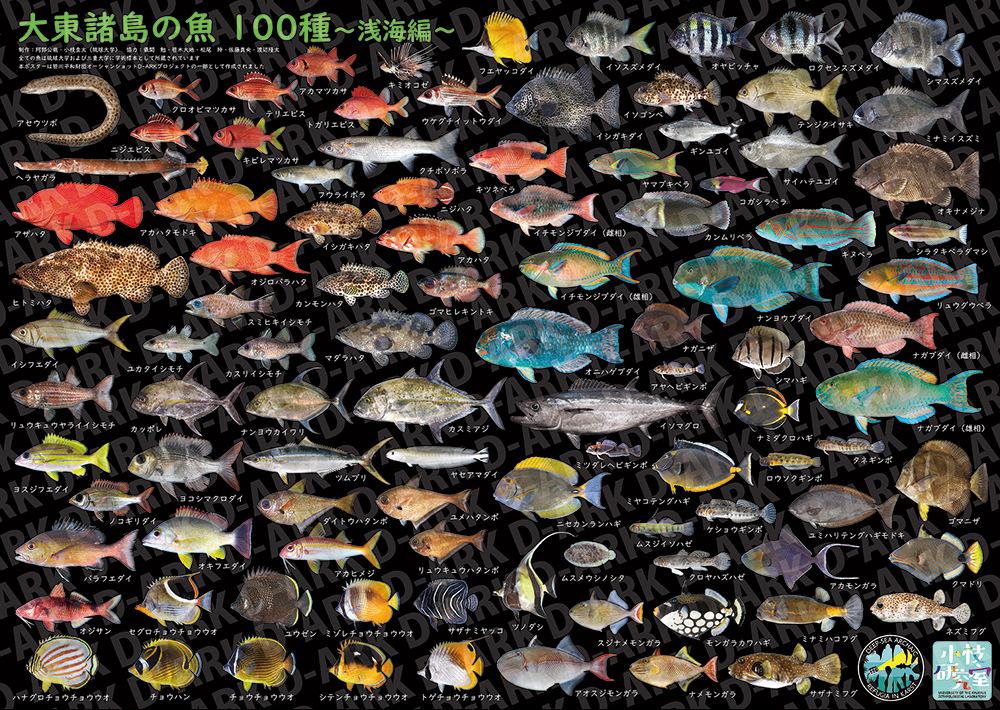
University of the Ryukyus (2026) Design and distribution of outreach materials: poster and clear file “100 Fish Species of the Daito Islands: Shallow-water Edition.”
Television Appearances
NHK (2025) Event to raise awareness of deep-sea environments and organisms. NHK News Okinawa. June 2, 2025
NHK (2025) Research team exploring deep-sea caves delivers a special class. NHK News Okinawa. July 17, 2025
Nippon TV (2025) High-performance underwater drone. Hakase wa Kyo mo Shitto Suru. May 25, 2025.
Nippon TV (2025) Targeting the king of the deep sea in Japan’s deepest bay! Discovering a variety of deep-sea creatures. The! Tetsuwan! DASH!!. August 24, 2025.
TV Tokyo (2025) Exploring the unknown deep sea with underwater drones. Breakthrough. September 27, 2025.
Newspaper Articles
The Chugoku Shimbun (2025) In search of unknown deep-sea species. June 5, 2025
The Chubu Keizai Shimbun (2025) Searching for unknown deep-sea organisms. July 7, 2025
The Ehime Shimbun (2025) Searching for unknown deep-sea organisms. June 2, 2025
The Ise Shimbun (2025) Searching for unknown deep-sea organisms. June 5, 2025
The Kobe Shimbun (2025) Searching for unknown organisms in the deep sea: exploration of caves around the Daito Islands. June 2, 2025
The Kyoto Shimbun (2025) Searching for unknown deep-sea organisms. June 11, 2025
Nikkei (The Nikkei) (2025) New polychaete species living on sponges adapts to low-sediment environments: discovery by Nagoya University and collaborators. November 16, 2025
The Nishinippon Shimbun (2025) Searching for “living fossils” in the deep sea. June 12, 2025
The Okinawa Times (2025) Searching for unknown organisms in deep-sea caves around the Daito Islands: JAMSTEC researcher aims to find “living fossils”. June 1, 2025
The Okinawa Times (Warabi) (2025) Into the unknown deep sea world. June 29, 2025
Ryukyu Shimpo (2025) Searching for unknown organisms in deep-sea caves around the Daito Islands using unmanned vehicles. June 1, 2025
Ryukyu Shimpo (2025) New species of polychaete discovered in deep waters off Minamidaito: attaches to sponges using sucker-like structures. November 5, 2025
Ryukyu Shimpo (2025) New zoantharian species discovered in Minamidaito. November 9, 2025
Ryukyu Shimpo (2025) First record of a Kuhlia species (flagtail) from Minamidaito reported by University of the Ryukyus researchers. November 15, 2025
Ryukyu Shimpo (2025) “Super Saiyan”-like new goby species discovered off Ishigaki Island by University of the Ryukyus researchers. November 28, 2025
The Sanyo Shimbun (2025) Searching for unknown organisms in the deep sea: cave exploration around the Daito Islands. June 2, 2025
The Shikoku Shimbun (2025) Searching for unknown deep-sea organisms. June 1, 2025
The Tokushima Shimbun (2025) Searching for unknown organisms in the deep sea. June 20, 2025
Tokyo Shimbun (2025) Approaching the mysteries of the deep sea. June 11, 2025
The Yamanashi Nichinichi Shimbun (2025) Exploring the deep sea in search of “living fossils”. June 23, 2025
Other Media Coverage
JAMSTEC BASE (2026) First-ever capture of bioluminescent organisms inside deep-sea caves: discovery of new and rare species reveals a mysterious ecosystem in unexplored “deep-sea limestone caves”—the D-ARK Project. March 18, 2026.
Bunkyo Digital (2025) New goby species “Eleki-haze” inspired by Dragon Ball
CORAL: The Reef & Marine Aquarium Magazine (2025) Frieza’s Next Nemesis: Supersaiyan Goby (Vanderhorstia supersaiyan). Vol. 23: 8–10
Daily Portal Z (2025) Discovery of a new fish species! What is the “Super Saiyan-like goby”? Interview with discoverer Hirasaka. March 18, 2025.
Science Portal (2025) A new goby species with a vivid yellow band—did they catch a popular character? December 3, 2025.
Web Articles / SNS
Enosui cruise diary (in Japanese)
D-ARK Cruise 2025 (1): Departure and transit.
D-ARK Cruise 2025 (2): First dive and hydrozoan collection
D-ARK Cruise 2025 (3): Baited camera and Crambon
D-ARK Cruise 2025 (4): Final day at Komahashi Daini Seamount and transit to Minamidaito Island
D-ARK Cruise 2025 (5): Introduction of the “X Scope” and suspension of operations
D-ARK Cruise 2025 (6): First deployment of Crambon and initial cave exploration
D-ARK Cruise 2025 (7): Crambon dive and second exploration of “Labyrinth.”
D-ARK Cruise 2025 (8): Two “Pig-nose” surveys and live broadcast of deep-sea cave exploration
D-ARK Cruise 2025 (9): Searching for new caves and “Cave Cam.”
D-ARK Cruise 2025 (10): Return of the “X Scope” and baited trap deployment
D-ARK Cruise 2025 (11): Retrieval of baited traps and transit to offshore Ashizuri
D-ARK Cruise 2025 (12): Ultra-sensitive camera and bioluminescence of sea cucumbers
D-ARK Cruise 2025 (13): Toward the Daito Islands and “Tripod Finder 2” with Cave Cam
D-ARK Cruise 2025 (14): Dive surveys in Suruga Bay and an unexpected final day
D-ARK Cruise 2025 (15): Completion of the survey and aftermath
D-ARK Cruise 2025 (Special Edition): Fishing survey highlights
D-ARK Survey: Kitadaito Island (Part 1)
JAMSTEC Official SNS (in Japanese)
- JAMSTEC × Enoshima Aquarium collaborative livestream (archive 1): Discovery of a new species during deep-sea cave exploration—what is its name? June 2, 2025
YouTube - JAMSTEC × Enoshima Aquarium collaborative livestream (archive 2): Quiz—Which is the “Horaana hisui yasemutsu” discovered in deep-sea caves? June 9, 2025
YouTube - JAMSTEC × Enoshima Aquarium collaborative livestream (archive 3): The “deep-sea endoscope” capturing organisms inside caves up close. June 16, 2025
YouTube - D-ARK Press (6) Exhibition of rare organisms at “Zoology Square” (Zoological Society of Japan Meeting), September 6. September 2, 2025
Instagram, X - D-ARK Press (7): New species paper published—Daito climbing ribbon worm. October 1, 2025
Facebook, Instagram, X - D-ARK Press (8): New species paper published—sucker-bearing polychaete. December 12, 2025
Facebook, Instagram, X - D-ARK Press (9): New species paper published—Bioluminescent zoantharian. December 15, 2025
Facebook, Instagram, X - D-ARK Press (10): Renewal of the “Deep Sea I – Joint Research with JAMSTEC” area at Enoshima Aquarium. February 5, 2025
Facebook, Instagram, X - New article: first-ever capture of bioluminescent organisms inside deep-sea caves—discovery of new and rare species reveals a mysterious ecosystem in unexplored “deep-sea limestone caves,” the D-ARK Project. March 18, 2026
Facebook, X
FY2024
Research paper
First northwestern Pacific records of the deep-sea cardinalfish Epigonus glossodontus (Teleostei, Epigonidae) from the Daito Islands, Japan
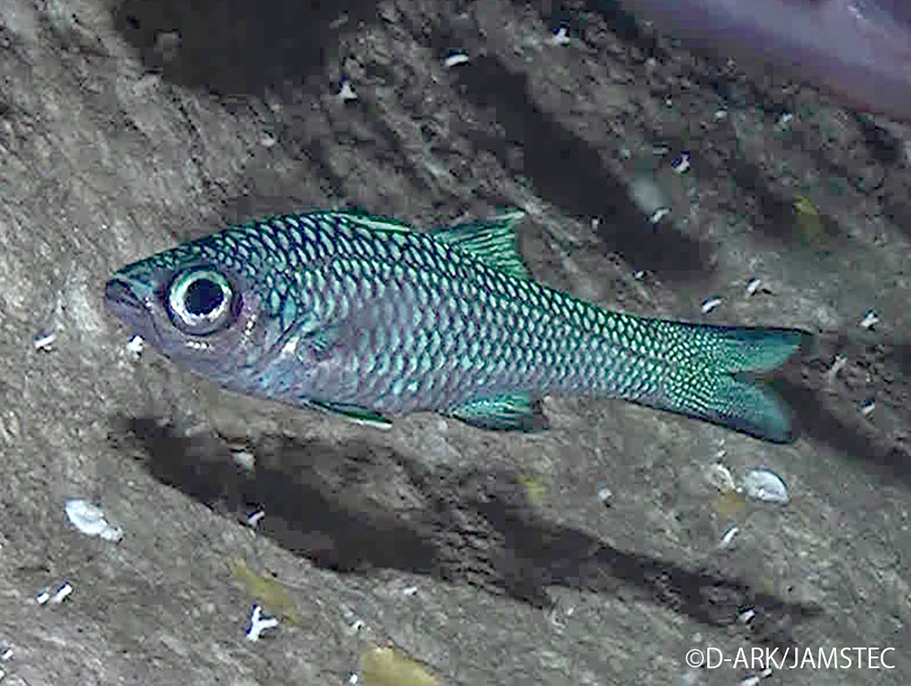
The deep-sea cardinalfish Epigonus glossodontus Gon, 1985, previously known only from the Hawaiian Islands, was observed on steep seafloors surrounding Kitadaito and Minamidaito islands, both being oceanic islands belonging to the Daito Islands, Japan in the northwestern Pacific. Sparse populations were mainly observed at depths of 340–588 m, around or within small caves, fissures, and recesses. A glossy bluish-green body color with black-margined scales was revealed by the field observations, the glossy color fading immediately after death. Its Japanese name is "ホラアナヒスイヤセムツ"(Horaanahisui-yasemutsu, meaning "cave jade deep-sea cardinalfish").
Mao Sato, Shohei Ito, Yoshihiro Fujiwara, Keita Koeda(2025). “First northwestern Pacific records of the deep-sea cardinalfish Epigonus glossodontus (Teleostei, Epigonidae) from the Daito Islands, Japan” Zookeys 1231:1-10 DOI: 10.3897/zookeys.1231.136445
University of the Ryukyus Official Website: https://www.u-ryukyu.ac.jp/news/64937/
A New Species of Flabelligena (Annelida: Acrocirridae) from the Western Pacific
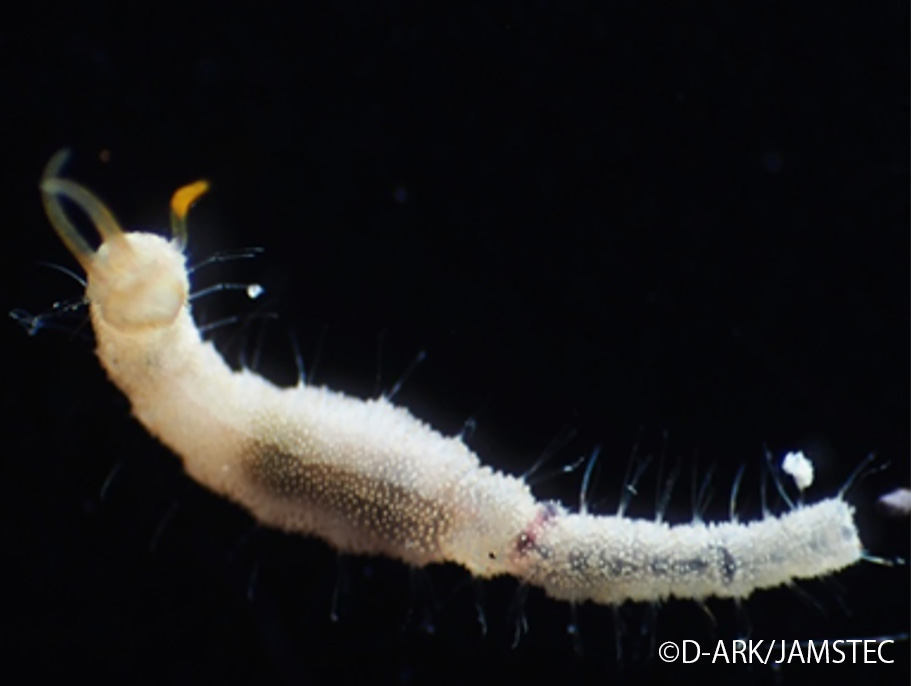
We discovered a new species of polychaete worm, Flabelligena daitoensis, belonging to the family Acrocirridae. This species is the first to be described from the Pacific Ocean. This species inhabits sandy environments at depths of 644 to 774 meters. The polychaete genus Flabelligena has previously been described from the Atlantic, Mediterranean, Indian, and Antarctic oceans.
The specific name daitoensis is derived from the fact that this species was first discovered near Minamidaito Island. Its Japanese name is "ダイトウヒメクマノアシツキ" (Daito-hime-kumanoashitsuki).
Naoto Jimi, Natsumi Hookabe, Shoki Shiraki, Hiroyuki Yokooka, Sau Pinn Woo, Shinji Tsuchida, and Yoshihiro Fujiwara (2024). “A New Species of Flabelligena (Annelida: Acrocirridae) from the Western Pacific." Species Diversity, 29(2), 415–421. DOI: 10.12782/specdiv.29.415
Presentations
Bergman LA, Koeda K, Reimer JD, Sentoku A, Chris M, Yokooka H, Sato M, Bacharo KBB, Tsuchida S, Fujiwara Y (2025) Diversity across the Philippine Sea: benthic megafauna community composition across four ridges in southern Japan. 17th Deep-Sea Biology Symposium
Received the Early-Career Research Award
Bergman LA, Koeda K, Reimer JD, Sentoku A, Yokooka H, Sato M, Bacharo KBB, Tsuchida S, Fujiwara Y (2025) Examining benthic megafauna community composition across four ridges in the Philippine Sea. JAMSTEC International Day 2025
Hookabe N, Fujiwara Y (2025) Ribbon worms from hydrothermal vent fields and seamounts. 17th Deep-Sea Biology Symposium
Received the Early-Career Research Award
Bacharo KBB, Lalas JA, Hakim AA, Fourreau CHL, Kise H, Sentoku A, Yokooka H, Hookabe N, Horowitz J, Tsuchida S, Fujiwara Y, Reimer JD. Nippon’s marine jewels: Preliminary findings on black corals (Antipatharia) of southern Japan. The 27th Annual Meeting of the Japanese Coral Reef Society
Bacharo KBB, Villareal K, Kise H, Sentoku A, Yokooka H, Horowitz J, Hookabe N, Tsuchida S, Fujiwara Y, Reimer JD (2025) Illuminating the diversity of deep-sea anthozoans found in selected sites of the Northwestern Pacific. 17th Deep-Sea Biology Symposium
Bacharo KBB, Villareal K, Monroy MPM, Kise H, Sentoku A, Yokooka H, Hookabe N, Horowitz J, Tsuchida S, Fujiwara Y, Reimer JD (2025) Diversity and distribution of anthozoan specimens collected during the 2020-2024 JAMSTEC expeditions in the northwestern Pacific. Ocean and Earth Symposium 2024
Fujiwara Y, Kawato M, Yoshida T, Tsuchida S, Hookabe N, Bergman L, Koeda K, Sentoku A, Reimer JD, Bacharo, KBB, Jimi N, Bessho-Uehara M, Yamanaka T, Shiraki S, Sato M, Kise H, Yamaki A, Ohno A, Yokooka H, Ito S, Mitsufuji K, Koyama Y, Yasuda T, Okamura G, Vendetti Jann, Sugimoto Y, Shinomiya Y, Tun HA, Fujioka R (2025) Overview of KM24-03 Leg 2 Cruise. Ocean and Earth Symposium 2024 (in Japanese)
Fujiwara Y (2024) Introduction to Deep-Sea Biology. Special Lecture on Life Sciences. Aoyama Gakuin University. (in Japanese)
Koeda K, Sato M, Ito S, Ohno A, Bergman L, Tsuchida S, Fujiwara Y (2024) The fish fauna of deep-sea karst in the Daito Islands. The 2024 (59th) Annual Meeting of the Ichthyological Society of Japan (in Japanese)
Misato Sako, Yoshihiro Fujiwara, Naoto Jimi (2024) An undescribed species of Dendronephthya (Cnidaria, Octocorallia) from Kita-Koho Seamount. Annual Meeting of Plankton and Benthos Society of Japan 2024
Newsletter
Bacharo KBB, Bergman LA, Kise H, Sentoku A, Yokooka H, Ohno A, Tsuchida S, Fujiwara Y, Reimer JD. (2024). JAMSTEC KM24-03 (Leg 2) Deep-Sea Cruise: Report on the cnidarians of the Daito Islands, Philippine Sea. Deep Sea Life, 23: 11-12.
Vendetti J (2024) Dispatches from the D-ARK: Follow Curator of Malacology Jann Vendetti with updates from an expedition into the deep sea caves around Japan's Minami-Daito Island. National History Museum Los Angeles County. https://nhm.org/stories/deep-sea-caves-expedition-japan
Exhibitions / Events
JAMSTEC, Enoshima Aquarium (2025) [Live Stream] New Species Discovered! Exploring the Mysterious Deep-Sea Caves "D-ARK". Enoshima Aquarium
JAMSTEC official YouTube chennel/Niconico Live Streaming
Yamaki A, Ito S, Koeda K, Kawato M, Bergman L, Narushima H, Fujiwara Y (2025) Live coverage of underwater drone survey ~ Off the coast of Enoshima ~ Vol.9 D-ARK Special. Enoshima Aquarium (in Japanese)
Fujiwara Y (2025) Special lecture “D-ARK”. Enoshima Aquarium (in Japanese)
Ito S (2025) Underwater drone piloting experience. Enoshima Aquarium (in Japanese)
Enoshima Aquarium (2024–2025) Special exhibition “Enosui Deep-sea exhibition - 200% Deepness-”. Enoshima Aquarium
Enoshima Aquarium (2024) Aquarium exhibit: "Display of deep-sea creatures collected at D-ARK". Enoshima Aquarium
SNS / Mass media
Enosui cruise diary (in Japanese)
D-ARK cruise (1) April 27th: D-ARK departs for unknown waters
D-ARK cruise (2) April 29th: Finally Arrived! Minamidaito Island
D-ARK cruise (3) April 30th and May 1st: Two Underwater Robots Launch!
D-ARK cruise (4) May 2nd, May 3rd Mini ROV, Baited camera, fishing collection, CTD water sampling
D-ARK cruise (5) May 4th, May 5th Endoscopic camera, CTD, Baited camera again
D-ARK cruise (6) May 6th and May 7th Two caves
D-ARK cruise (7) May 8th and May 9th: Enthusiastic fishing expeditions and cave exploration
D-ARK Voyage (8) May 10th and May 11th: Transition: D-ARK's survey for this year ends safely, and we head to the Kyushu-Palau Ridge.
JAMSTEC Official SNS (in Japanese)
- Ocean shot Project “D-ARK(Deep-sea Archaic Refugia in Karst)” Kicks Off!
X Facebook - D-ARK Press (1) Large deep-sea cave discovered during first cruise!
X Facebook Instagram - D-ARK Press (1) Large deep-sea cave discovered during first cruise! video
X Facebook Instagram Youtube - D-ARK Press (2) New Deep-Sea Exhibit Now Open at Enoshima Aquarium!
X Facebook Instagram - D-ARK Press (3) D-ARK’s First New Species! Paper on “Daito-hime-
X Facebook Instagram Youtube - D-ARK Press (4) “Deep-Sea Exhibition” Now Showing at Enoshima Aquarium!
X Facebook Instagram - JAMSTEC × Enoshima Aquarium Live Stream Promo #1
X - JAMSTEC × Enoshima Aquarium Live Stream Promo #2
X - D-ARK Press (5) Japan’s First Record! Paper on “Horaanahisui-yasemutsu” Published!
X Facebook Instagram Youtube
Darwin’s Amazing Animals Official X “exclusive coverage of the research cruise conducted in the waters around Minamidaito Island” (in Japanese)
Special drama " Darwin’s Amazing Animals is coming!?", August 20, 2024. NHK TV
Award